The tales of the end of the Earth are now posted and are being discussed over at the newest Accretionary Wedge hosted by Lockwood at Outside the Interzone.
Submissions vary from the humerous to "some serious pieces debunking this whole doomsday nonsense".
Nonsense? You won't be saying that Saturday when the world is over.
Showing posts with label Armageddon. Show all posts
Showing posts with label Armageddon. Show all posts
Thursday, December 20, 2012


Sunday, December 16, 2012
AW#53 - Countdown to Oblivion
This is an entry for AW#53 which is a special edition highlighting the end of everything. Please be aware that everything in this article is fictitious, unless it turns out to be true, then it is prophetic.
----------------------------------------------------------------------------
December 16th, 2012. News reports are striking fast and furious. Hollywood has made a fortune capitulating on the end of days with such movies as End of Days, Armageddon, 2012, Deep Impact, The Day After Tomorrow, The Core and other seemingly hopeful looks into out future. But the time has come and it appears that those movies were more opportunistic than reality appears to be.Giving credit where credit is due, the Mayans score another point. Mayans 2 Earth 1.
Armageddon (the actual one, not the movie) is scheduled to arrive in 5 days at Noon EST, Friday (December 21st, 2012) judging by the look of the skies it may arrive a little early. Weather reports are calling for fire and brimstone based from a rouge series of asteroids (the actual one, not the video game) previously undetected. The asteroids are made up of a rare form of plutonium, not before known to exist in the asteroid belt. Tracking the trajectory of the asteroids back they appears to have been knocked out of the asteroid belt by a serious of collisions instigated by a gravitomic shift of Jupiter's orbit precipitated by the Shoemaker Levy comet impact back in 1994. Previous reports did not detect any impending apocalypse. The gravitomic shifts caused the asteroids to start bouncing around the asteroid belt like a giant game of pinball, resulting in several smaller and a few larger asteroids being ejected into Earth's orbit.
Fortunately, the resulting impact of the asteroids into the surface of the Earth will only effect one side of the Earth, the western hemisphere. Unfortunately the plutonium is expected to create a nuclear explosion large enough to impact the furthest regions of the Eastern Hemisphere within 12 hours of impact. The intense heat from the combination of the impacts and nuclear explosions is expected to cause a fissure along the center of the Earth forcing the Earth to fracture, much like a head of lettuce slammed into a table. Unlike a head of lettuce, this is not likely to be palatable to most residence of the Earth.
There is one beacon of hope though. It appears in 90% of all predictions the resulting meltdown of the Earth will leave the Christmas Islands untouched. It is unknown the exact reason for this miracle but all flights to the Christmas Islands have been booked at this time.
I would wish everyone a Merry Christmas but the point has become rather moot.
UPDATE: Further models have indicated that although the Christmas Islands will survive the initial impact, it turns out that they will eventually succumb to the apocalyptic events, ironically enough, on Christmas Day, December 25th, 2012. Reports of this update has caused an increase in flights being booked to the Easter Islands in hopes a similar string of events will give them a few months longer to live.
Booked flights are also on the rise for the Intercourse Islands. It is unknown why.
Sunday, August 28, 2011
Geological Movie Review - Armageddon: An Update
Last year I had posted a series of updates going into a geological movie review of Armageddon in depth (You can go here for a link to all the individual updates). One of my readers has recently made a discovery that answers an unsolved question I had about the movie. In the post I state:
 A recent contact by Brian Pontz has suggested that the "single engine (ok), press, demi-go" is not actually what they were saying. The subtitles clearly show them saying "demi-go" but this may be made up by the script-writers to mimic what is actually said by astronauts. Brian suggests that they are actually saying "Single Engine Press to MECO". NASA explains this phrase as meaning "that orbit can now be reached on only one main engine". Since this makes much more sense in context of the movie, especially at this particular point in the movie, and it actually being a real-life phrase, I would say that Brian is right and the subtitles are wrong.
I would like to thank Brian for bringing this to my attention and I welcome anyone else who finds out something I missed or made a mistake on to contact me with the correct information.
After the boosters separate, they then state "single engine (ok), press, demi-go." Now demi-go is another phrase that does not seem to have made it anywhere in the greater world. So whatever that is I also do not know.
 A recent contact by Brian Pontz has suggested that the "single engine (ok), press, demi-go" is not actually what they were saying. The subtitles clearly show them saying "demi-go" but this may be made up by the script-writers to mimic what is actually said by astronauts. Brian suggests that they are actually saying "Single Engine Press to MECO". NASA explains this phrase as meaning "that orbit can now be reached on only one main engine". Since this makes much more sense in context of the movie, especially at this particular point in the movie, and it actually being a real-life phrase, I would say that Brian is right and the subtitles are wrong.
I would like to thank Brian for bringing this to my attention and I welcome anyone else who finds out something I missed or made a mistake on to contact me with the correct information.
Tuesday, August 31, 2010
Geological Movie Review of Armageddon - Overview
Since I have completed the Geological Movie Review of Armageddon, I am using this post as a compilation of all the previous posts as well as a link to the compiled collection
Armageddon - Part 3
Armageddon - Part 4
Armageddon - Part 5
Armageddon - Part 6
Armageddon - Part 7
Armageddon - Part 8
Armageddon - Part 9
Armageddon - Part 10
Armageddon - Part 11
Armageddon Questions
Armageddon - August 2011 Update
Also you can find all this information in one easy location at my website:
http://www.dinojim.com/Geology/GeoEducation/Armageddon.html
Armageddon - Part 4
Armageddon - Part 5
Armageddon - Part 6
Armageddon - Part 7
Armageddon - Part 8
Armageddon - Part 9
Armageddon - Part 10
Armageddon - Part 11
Armageddon Questions
Armageddon - August 2011 Update
Also you can find all this information in one easy location at my website:
http://www.dinojim.com/Geology/GeoEducation/Armageddon.html
Geological Movie Review of Armageddon - Questions
Geological Movie Review of Armageddon - Overview
Here are some questions I designed to be asked in a class while reviewing Armageddon. You can also find a PDF of this information at my website (linked through the overview page).
This is a list of geological questions based on the movie Armageddon. Some of the questions can be answered while watching the movie, while others will need extra research on the internet. Some will be both. This is to help broaden your understanding of the geological world and how Hollywood can distort basic scientific principles to make a hit movie.
1. When was the impact that killed the dinosaurs?
2. When describing the impact that killed the dinosaurs it is mentioned in the movie as having the force of 10,000 nuclear weapons. Why is this a poor measure of energy?
3. How high up are geosynchronous satellites usually orbiting?
4. Being that high up, would you expect the meteors that hit the shuttle and the satellite to have a fire trail?
5. How should meteors fly in relation to one another in a meteor shower? Why?
6. Compare the movement of the meteors/meteorites in the movie. Do they differ from how they should fly? If they do, how?
7. What are the largest and second largest asteroids in the asteroid belt? How do they compare to the asteroid size in the movie? (Assume the diameter of Texas is 780 miles)
8. What are some of the methods they come up with to destroy or move the asteroid? Will they work or not? Why?
9. What caused the asteroid to hit the Earth? Is this possible? Is it possible with a far smaller asteroid?
10. The Russian Space Station that they fly to is better known as what? Why would it not be possible to dock at the station if the movies took place today?
11. Does the Russian Space Station have “artificial gravity” in real life?
12. Has the “gravitational slingshot” ever been done in real life or is this a product of science fiction. If it has, when?
13. What would the surface of the asteroid actually look like and why? Like the one in the movie? Like the Earth? Like the moon?
14. Would drilling an 800 ft hole in a 780 mile wide asteroid actually do anything in your own opinion?
15. What would you do faced in a similar situation?
Here are some questions I designed to be asked in a class while reviewing Armageddon. You can also find a PDF of this information at my website (linked through the overview page).
Armageddon (1998)
Geological review questions based on the movie
This is a list of geological questions based on the movie Armageddon. Some of the questions can be answered while watching the movie, while others will need extra research on the internet. Some will be both. This is to help broaden your understanding of the geological world and how Hollywood can distort basic scientific principles to make a hit movie.
1. When was the impact that killed the dinosaurs?
2. When describing the impact that killed the dinosaurs it is mentioned in the movie as having the force of 10,000 nuclear weapons. Why is this a poor measure of energy?
3. How high up are geosynchronous satellites usually orbiting?
4. Being that high up, would you expect the meteors that hit the shuttle and the satellite to have a fire trail?
5. How should meteors fly in relation to one another in a meteor shower? Why?
6. Compare the movement of the meteors/meteorites in the movie. Do they differ from how they should fly? If they do, how?
7. What are the largest and second largest asteroids in the asteroid belt? How do they compare to the asteroid size in the movie? (Assume the diameter of Texas is 780 miles)
8. What are some of the methods they come up with to destroy or move the asteroid? Will they work or not? Why?
9. What caused the asteroid to hit the Earth? Is this possible? Is it possible with a far smaller asteroid?
10. The Russian Space Station that they fly to is better known as what? Why would it not be possible to dock at the station if the movies took place today?
11. Does the Russian Space Station have “artificial gravity” in real life?
12. Has the “gravitational slingshot” ever been done in real life or is this a product of science fiction. If it has, when?
13. What would the surface of the asteroid actually look like and why? Like the one in the movie? Like the Earth? Like the moon?
14. Would drilling an 800 ft hole in a 780 mile wide asteroid actually do anything in your own opinion?
15. What would you do faced in a similar situation?
Monday, August 30, 2010
Geological Movie Review of Armageddon - Part 11
- Overview (or important thoughts to take home) -
- This movie is based on the concept that eventually an asteroid is going to strike Earth with the power to cause the extinction of the human race
- Fire trails can only be made by meteors in an atmosphere, so the meteors hitting the shuttle would not produce this effect
- Meteors that originate from a single source, like the asteroid, would only travel in parallel lines, so all meteors will travel at the same angle across the sky, unlike that seen in the movie
- For the meteor shower to hit the Earth the way described, the Earth would have to have traveled through a stream of meteors, not head on into it which is implied
- There are no asteroids in the asteroid belt "the size of Texas" and there is only one that is relatively close to that size
- For NASA not to know about the asteroid in advance it would have to have been struck by something to alter its trajectory dramatically, which is what happened
- There are theoretical comets that could hit and move the asteroid into our path but the chances are slim to none in a billion
- None of the plans to destroy or move the asteroid are feasible given their time frame, especially the one they choose
- Most asteroid destruction plans mentioned in the movie were taken from the NASA website as possible path altering options for asteroids, but only for ones that will not hit the Earth for several years
- An 800 foot hole is 0.02% deep into the 780 mile asteroid so a bomb will do no more damage then if it blew up on the surface
- Also the asteroid would be layered on the inside so no fault is going to run the length of the entire asteroid
- The equipment used at NASA is all possible equipment they could have now or invent in a short time. The NASA advisors must actually have known something
- Also the liftoff sequence and events all seem pretty close to real-life
- The fuel used on the shuttle is not compatible to the fuel available on Mir, and they would not have used any fuel in the main shuttle getting there anyway, so the trip to Mir was pointless
- Mir also could not produce gravity by spinning, nor would it be possible due to the shape of the station
- The "slingshot" around the moon was possible as shown in the movie
- The surface of the asteroid would resemble the moon more than anything else, no random growths, little to few valleys, and lots and lots of craters
- Should the destruction plan have actually succeeded there is no way a bomb would be powerful enough to break apart the two pieces of the asteroid and disintegrate all the smaller pieces while still keeping the two main pieces intact.
- Non-Geological Notes -
- Not much non-geology/NASA gripes I have with the movie
- I like this quote though:
- Lev - "Components, American components, Russian Components. All made in Taiwan!"
Sunday, August 29, 2010
Geological Movie Review of Armageddon - Part 10
Geological Movie Review of Armageddon - Overview

The interesting thing about the explosion is they did the Star Wars Special Edition shock wave off of the asteroid. This caused the shuttle to shake, rock and roll like nobodies business. Shockwaves are produced by ripples in the atmosphere. There is NO ATMOSPHERE in space, so again NO SHOCKWAVES. During the movie they should also get pummeled by rock debris as it pulverizes the shuttle. This happened in a small degree but certainly nothing as should have been seen in the movie. Also the all impressive explosion not only kept the 2 halves of the asteroid relatively intact, it also vaporized all the smaller fragments that would have come raining down. This whole, keep the asteroid from destroying Earth thing, keeps getting more and more impressive. So, all in all, if there was an bomb large enough to be capable of splitting an asteroid the size of Texas, I do not believe that it would split it in half without damaging either side and still vaporize anything else not attached to the asteroid.
Overall they seem to have a very good team of advisors. There is an interview with a couple of them on the bonus DVD that I do not have at the moment, so I have not seen what they might have thought of the movie. But it seems that a lot of their opinions were listened to in respects to NASA and any government stuff but when regular science comes into play things get a bit iffy. My guess is that they are going to keep their opinions of the movie rather neutral so that they have more possible advisory roles in the future. No point in burning bridges.
- Aftermath -
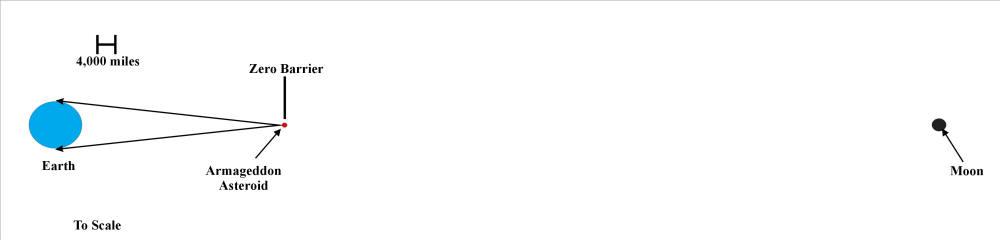
2:17:43 - All through the movie they are commenting on the "zero barrier". The point after which if they do not explode the bomb the asteroid will end up crashing into the Earth. Figuring out where exactly the zero barrier is in relation to Earth is fairly simple (See Figure to the right). Assuming they are moving at 22,000 mph and they start the 8 hours of drilling while they are next to the moon. The moon is approximately 238,857 miles away from the Earth, so the zero barrier is approximately 62,000 miles away from Earth (UniverseToday.com). This would take the asteroid about two and a half hours to reach us, assuming the asteroid does not speed up due to Earth's gravity pulling it in, which is likely, especially considering it is on a direct path to Earth. So even though the plan is not possible, I figured it would be interesting to find out how close they are letting the asteroid get to Earth before the all impressive bomb tore it in two parts.
The interesting thing about the explosion is they did the Star Wars Special Edition shock wave off of the asteroid. This caused the shuttle to shake, rock and roll like nobodies business. Shockwaves are produced by ripples in the atmosphere. There is NO ATMOSPHERE in space, so again NO SHOCKWAVES. During the movie they should also get pummeled by rock debris as it pulverizes the shuttle. This happened in a small degree but certainly nothing as should have been seen in the movie. Also the all impressive explosion not only kept the 2 halves of the asteroid relatively intact, it also vaporized all the smaller fragments that would have come raining down. This whole, keep the asteroid from destroying Earth thing, keeps getting more and more impressive. So, all in all, if there was an bomb large enough to be capable of splitting an asteroid the size of Texas, I do not believe that it would split it in half without damaging either side and still vaporize anything else not attached to the asteroid.
2:19:11 - Back to my trusty globe to see if people could really see the explosion all across the Earth. The first view of the explosion shows the Taj Mahal in India while some other views give the impression that Americans can also witness the explosion. The view of the explosion would be similar to a view of the moon, only parts of the planet would be able to witness it at any one time. India and the US are not even on the same side of the globe, so it would be impossible for India to see the explosion while those of us in the US witnessed it, based on planetary prospective.
- Advisory Input -
2:26:26 - So even though they did not have a "scientific advisor" on the movie they did have several advisors for other roles. Ivan Bekey was the asteroid consultant on the movie, which is as close to a scientific advisor as I think they got. He has written several books on the subject of asteroid and comet collisions and he is also a former NASA advanced planner and technologist (USA Today). Which likely means that the systems we have in place to defend against this ever happening has his signature somewhere on it. Joseph P Allen is the NASA Consultant who I feel did an excellent job. Overall there were very little problems with the NASA aspect of the movie. Allen was not only a physicist with NASA but was also an astronaut (NASA). Jerry Bostick was the movie's advisor on all of the Mission Control situations and I think he also did an excellent job. He had worked in Mission Control on both the Gemini and Apollo Programs as well as being the Director for the Energy Technology Applications Division of NASA (NASA). Harry Humphries was mainly their tactical advisor on all military matters. He was a Navy Seal and started his own company giving military consultation on over 17 movies (NavySeals.com)
Overall they seem to have a very good team of advisors. There is an interview with a couple of them on the bonus DVD that I do not have at the moment, so I have not seen what they might have thought of the movie. But it seems that a lot of their opinions were listened to in respects to NASA and any government stuff but when regular science comes into play things get a bit iffy. My guess is that they are going to keep their opinions of the movie rather neutral so that they have more possible advisory roles in the future. No point in burning bridges.
Saturday, August 28, 2010
Geological Movie Review of Armageddon - Part 9
- Life on an Asteroid -
- Composition and Shape -
 1:24:05 - Finally, we reach the asteroid. First off I want to describe what an asteroid that size would actually resemble, then we can compare it to the asteroid in the movie. Currently in science, it is believed that an object that size in space would be considered a dwarf planet. As of today (August 2010) there are 5 dwarf planets recognized Ceres, Pluto, Eris (formerly "Xena) (Space), Makemake, and Haumea. They are considered dwarf planets and not asteroids because they are very large and relatively spherical. They are spherical because at that size their gravity dictates a shape similar to their larger brothers (the planets). Based on size, both Ceres (pictured left) and Charon (Pluto's moon pictured right) are relatively the same size as the Armageddon asteroid. So the shape of the asteroid and any superficial features would be similar to both of those celestial bodies. Ceres and Vesta are the two largest asteroids in the Asteroid Belt (both pictured left) so their composition and internal structure would in theory be similar to the composition of the Armageddon asteroid. So for all intensive purposes, Ceres is the Armageddon asteroid .
 Overall the shape of the asteroid is going to be spherical. This is caused by its massive size and it probably would be considered a proto-planet, similar to Ceres (Space). The surface is going to look like any other object that sits inside an asteroid belt.
 It is going to be beaten and pot marked from countless numbers of other asteroids and debris crashing into it. Overall though, compared to its size the surface is going to be relatively smooth, with none of those weird growths as seen on the asteroid in the movie. Even after it gets pummeled by a comet there is no reason for the growths to be there, this is not an overly dynamic surface.
 The internal structure of Ceres is most likely layered, like Earth, due to some minimal heating during its formation. Although, the asteroid likely did not get as hot as the Earth, so the layering is not going to be perfect. But it is still going to be there (Picture left below). The surface of the asteroid is a thin dusty outer crust that might have some crystals of water that were released in the collision with the comet but nothing as gigantic as seen in the movie. It is now thought that Ceres might even have more water locked away in it's interior then all of Earth. This would, in essence, hinder any attempt at asteroid destruction by burying a bomb, since a fault would not run through the ice and the rock but it would follow the layers.
 Surrounding the asteroid in the movie was a cloud of "debris". The debris seems logical enough because the asteroid had the stuffing kicked out of it, which caused it to be hurtled towards Earth. Some of the debris that got knocked in the same direction as the asteroid is going to be flying at roughly the same speed. Some faster, some slower but overall they will be clumped together. This part of the movie I can see as feasible.
 In regards to the composition of the surface of Ceres, from what we know it is not uniform. So this would indicate that, yes, some areas are going to be rocky and some areas are going to have more iron in them (Space). The asteroid belt is the remains from a planet that never fully formed, or was ripped apart, so a majority of the asteroids have an iron-nickel composition. The surface of Ceres is a conglomeration of the other asteroids in its vicinity that crashed down onto the surface. So it is possible to have regions of compressed iron-ferrite (a variety of iron), if it got hit in that spot by a mostly iron asteroid sometime in the past.
- Arrival -
1:24:05 - On to the movie. We have already stated that the surface of the asteroid is going to look nothing like it did in the movie. In actuality I would say the surface is going to resemble the moon, more than less. As for the shape of the asteroid it is difficult to tell what shape they made it but I am going to go with it looks a little more like Eros (in the picture above) than Ceres, which would be the proper shape for an asteroid far smaller. Even if it was the size of Eros the surface would still be similar to the moon.
We already discussed the stunt flying as being feasible, although they are doing more tricks then I would say would be possible in real life but I say give them their fun. After their stunt flying, one ship crashed and the other one lands safely although very far (26 miles) off course. Maybe their high tech radar is not worth the money they spent on it. Seems more like a video game then an actual NASA program. Hey, maybe I could be an astronaut!
- Independence is Dead -
1:31:03 - Here is one of the major problems I found in the movie, although it is only a minor thing in the movie itself. The one shuttle that crashed is completely open to the atmosphere, or lack there of. This means no oxygen, none, zilch, zip. So how is there fire? Fire feeds off oxygen and there are not even oxygen lines that it is on so that I can justify it. There is no way that there could be fire in the torn open shuttle.
Moving on. Why does the Armadillo have a machine gun? Are they expecting Aliens or Predators to come out? My rambling does have a scientific point though, so don't worry. The machine gun is used to blast a hole in the side of the shuttle. Did anyone else notice that the titanium alloy shuttle that was built to withstand asteroids whipping into it was punctured like aluminum foil from the machine gun? They could have done something better with that whole scene.
1:38:33 - Remarkably, when looking at the background behind the Armadillo while Ben is arguing about how he doesn't know what a button does, it is possible to see what I would expect from the surface of an asteroid to look like. So it turns out that some of the surfaces in the movie are different depending on where they are. Although this would not be the case, since the asteroid would have more or less uniform surficial features, at least it shows the background like it should be at least once.
1:52:00 - When the Armadillo attempts their "Evel Knievel" stunt they release the thrusters, that were holding them down, then while they are in mid air they start them again on the other side. Theoretically this should work, since the escape velocity for the asteroid is so low. Assuming the Armadillo could handle the impact from the thrusters launching it back into the asteroid I think everything should work out alright. The only foreseeable problem would be when they are over the canyon that they did not achieve escape velocity and they end up falling, very slowly, back down to the asteroid. But by then they should be on the other side of the canyon anyhow. So either way it all works out.
- Freedom Reigns -
1:32:48 - The second shuttle made a rather safer landing on the other side of the asteroid. From their drill site they had a very good view of Earth. Now think. The asteroid is roughly the size of Texas, 780 miles in diameter, and it is traveling at ~22,000 mph. The shuttle is traveling at 22,500 mph, which is in relation to the asteroid, about 500 mph. So to get from the back of the asteroid to the front side facing the Earth where they landed would take about 2 hours. Definitely not even close to the amount of time it took them, even if they cut down the time for entertainments sake.
After the landing the second shuttle starts to drill. I already stated that it is possible to have an iron plate on the surface, so that is ok. The drilling speeds are justified, 57 feet in 2 hours through solid iron, ok so far. The one main problem I have with this I described previously when they came up with the plan. The asteroid is not going to be a solid object. There is no fault that runs the length of the entire asteroid since it is layered and 800 feet barely scratches the surface of the thing, so whatever they do it does not matter. Even if the layers are different then Ceres and there is not a water layer it is still going to be layered and different layers will not fault the same. Just explode the bomb on the surface you will do just as much damage as if it were 800 feet down.
So now that we know that everything they do is useless anyway lets go on to the working conditions. While they are working on the asteroid they seem to have all the struggles they would on Earth. The problem though is that due to the size of the asteroid it would only have about 3% the gravity of Earth (ASI.org). I will take it for granted that when they are walking, it is similar to Earth because the suits hold them against the ground (due to the thrusters) but the other equipment like the transmission for the drill would weigh practically nothing where just 2 of them would be able to move it. A 1000 pound piece of equipment would only weigh 30 pounds so unless the drill transmission weighed 10,000 pounds on Earth I see no reason why they would need 3 or 4 people to move it.
- Unstable Trajectory -
1:37:39 - As previously commented on, the moon's gravity actually did have an effect on the asteroid. Yea for science. But unlike the slight slingshot effect that I predicted, they stated that the rotation of the asteroid was altered from a 1 axis spin, like the Earth's, to a 3 axis spin, like a poorly thrown football. In reality the moon's gravity is going to have a great deal of effect on the asteroid due to its proximity. The real question is what it will be and why did the "geniuses" at NASA think there would be no effect? Perhaps the asteroid is moving too fast and too far away for a complete slingshot effect but the gravity did pull it resulting in the rotational effect seen in the movie. So in real life this is most likely the probably outcome. Well they can't get them all wrong, can they?
The reason that communications are cut off are related to this as well. Before the asteroid changed its spin it was rotating on the x-axis, meaning that the same side should be facing the planet the entire time. So radio communication would be uninterrupted. But since radio contact is a line of sight thing, if the asteroid is turning then you will loose the line of sight eventually causing a "communications blackout", essentially what happened in the movie.
Luckily through all the tumbling this thing is going through they are always able to see Earth from the digging site. What? How is this even possible? And how do they have a communications blackout? One minute it is tumbling uncontrollably the next it is stable with a clear view of Earth. Can they keep anything consistent in this movie?
- Breaking Up -
2:04:58 - Now for some unknown reason the asteroid starts to breakup. Fire trails are produced from random asteroid chunks being tossed around. My best guess is that since the asteroid is now caught in between the gravity wells of the Earth and the moon, the 2 bodies are tearing the asteroid apart. As described way earlier, there would be no fire trails since there is no atmosphere to burn them up so that is a mute point as this time. In regards to the asteroid being torn apart, I would say that it would happen over a period of time, not all of the sudden, but I agree that it would likely happen. With the speed that things are happening in the movie, I feel that this whole experience is similar to how it should happen, just in fast forward.
Thursday, August 26, 2010
Geological Movie Review of Armageddon - Part 8
UPDATED - August 28th, 2011 and February 21st, 2014
- Liftoff -
1:07:10 - Here is where we start to actually save the world. Several of the things going on, starting now, have been discussed already so I will only stick to the facts that I have not yet covered. The liftoff is the first part. In the movie, before liftoff, they do a preliminary check of all flight directors. These are: Retro; Booster; ECOS; Trajectory; FIDO; EVA: CAPCOM Freedom; and CAPCOM Independence. Even though in real life several Go/No Go sequences are performed on the rockets prior to liftoff, a very short one is the last one they do. During the launching of the Swift Spacecraft the last check they did has a video Here and I do not recognize any of the terminology they use. So my guess is that Hollywood changed the order of the checks to only put the ones that might be recognizable at the end for the pleasure of the viewing audience.
An in-depth description of each of the things that were checked off before launch are:
(Parenthesis indicate actual NASA titles that correspond with the movie titles)
Retro - This is a check of the retro rockets, which are the rockets that slow the booster preparatory down so it can fall back into the atmosphere (NASA).
Booster - (Booster Engineer) The engineer monitors and evaluates the main engine. This is one of the main stations.
ECOS - This stands for "Experiment Computer Operating System", which is the primary man-machine interface. It provides for control over experiments by presenting the necessary control data over display units. How this actually helps in a launch I am not sure. (Jean and Lee, 1981).
Trajectory - (Guidance Procedures Officer?) They monitor the onboard navigation and guidance computer software. Another main station.
FIDO - (FDO - Flight Dynamics Officer) Another main station at NASA. They plan maneuvers and monitor trajectory in conjunction with the guidance officer.
EVA - The only thing I think could work for this was Extravehicular Activities meaning anything done outside the shuttle in space. Why were they checking for this now? I don't know (NASA).
CAPCOM - (Spacecraft Communicator) They are the primary control between flight control and the astronauts. This is the primary station at NASA during the shuttle flight.
They then go into some more NASA jargon stating "P.L.T.s, perform your A.P.U. pre-start". The P.L.T. is simply the pilot of the shuttle and the A.P.U. stands for Auxiliary Power Units. The statement indicates to the pilot to start warming up the engine fuel so that the shuttle is ready for launch (NASA). This usually occurs at about T-6 minutes to launch. There is a ton of other things that they left out of the movie, but again for the sake of simplicity and entertainment, I think they just cut it down to the nitty gritty.
One of the unique things about this launch is that it is a dual launch with 2 shuttles at the same time. Now, I do not see anything really wrong with this except that it would take twice the manpower to monitor the shuttles. And seeing that this is a global emergency I would imagine that if they needed 2 shuttles then they would definitely send them off at the same time, although they might want to send them from different locations to avoid the shuttles crashing into each other.
While they on their initial space flight we have some more terminology. They state that they have a max cue and S.R.B. What a "max cue" is I do not know and I don't think that NASA does either.
UPDATE: An anonymous comment suggested that "max cue" may actually mean "max Q". The Max-Q is where the air pressure pushing against the shuttle as it ascends reaches its maximum. This is a similar effect as when you hold your hand out of a car window. "Q" stands for the dynamic pressure of the air (aerospaceweb.org). This is likely a misprint in the subtitles as this seems to make complete sense in the scene.
The SRB on the other hand is the Solid Rocket Boosters and they were released at the time of the announcement, about 125 seconds after launch (Spaceline). In the movie the external tanks (ETs) are released in conjunction with the SRB's and then the main engines shut down shortly after that. In reality when the SRB's are released the external tanks remain connected to the shuttle until engine shutdown. They are then released about 18 seconds after that (NASA). So essentially everything does not fall off of the main shuttle all at once. It comes off in stages. After the boosters separate, they then state "single engine (ok), press, demi-go." Now demi-go is another phrase that does not seem to have made it anywhere in the greater world. So whatever that is I also do not know.
So, overall the launch sequence makes sense and although it was shortened it seemed pretty close to real life. My only question is, did they really make up terminology, since I can not find it anywhere, and if they did, why?
- Russian Space Junk
(AKA Mir the intergalactic gas station) -
(AKA Mir the intergalactic gas station) -

1:10:46 - The first stop on their trip around the cosmos is the Russian Space Station. Luckily the asteroid was going to hit Earth before 2001 because the Russian Space Station, otherwise known as Mir, crashed into the atmosphere in 2001. The movie states that the space station is 11 years old, and since the first parts of Mir went up into space 1986, this means the movie takes place in 1997 (RussianSpaceWeb). During the construction of Mir several docking ports were added, moved and taken away, but in the final stage of the station there were multiple spots that could be used for docking, including the 2 locations that the shuttles attached to in the movie.
The one major, and I mean MAJOR, problem with the space station is that there is no "artificial gravity" projector on the station. In theory, if they just rotate the station, then they will be able to produce centrifugal force against the outer surface of the space station, simulating gravity. To produce an effect similar to Earth's gravity, the station needs to rotate at a remarkable rate of speed. Also the "gravity" would be the same, and probably minimal, along all of the outer walls of the central tube but it would be the strongest furthest from the rotation axis in the jutting arms (AstroProf). So it would be impossible to "walk" along the central shaft since there would be practically no gravity there, even if it was rotating fast enough in the first place.
The purpose for the layover at Mir is to refuel the 2 shuttles, that way they have enough fuel to make it to the asteroid and back. The main problem I see with this is that when escaping the Earth's gravity, huge fuel canisters were emptied and then dropped back into the atmosphere. So very little fuel from the remaining part of the shuttle was used to get to the station. So either they left the shuttle almost empty of fuel to make it easier to get into space or the movie producers did this for dramatic effect. Um, I go with the almost empty theory because that will give me more to talk about. So when they dock with Mir there are two types of fuel they could be getting. 1. Fuel that the station holds specifically for refueling shuttles. or 2. Its own supply of fuel for supporting life and all the stations daily duties. Overall Mir is powered by rechargeable batteries that use solar power, so any fuel on the station is going to only power the propulsion system that keep the station in orbit. Mir did have multiple locations to hold the fuel, but definitely not enough fuel to act as an intergalactic gas station (NASA). Even the location of the fuel storage in the movie was inaccurate. The part that they state is the "fuel pod" is just the docking compartment on another portion of the station. So, overall this means that they had to take fuel from their own reserves to fuel the shuttles, which considering the situation is entirely possible, but would not amount to that much fuel.

The type of fuel though, is very important to the refueling process. Space shuttles typically run off the interaction of hydrogen and oxygen since that produces a tremendous amount of energy. Unfortunately they must be kept very cold so this is not the ideal fuel for long missions. Also when they are refueling the shuttles in the movie they only have one pipe of fuel, so it could not be both oxygen and hydrogen. This also eliminates a fuel called hypergolic fuel, which is a lower temperature fuel but still needs a reactant, hence 2 tubes again. The movie also eliminates the solid fuels since, it was obviously liquid they were pumping out of the station. This just leaves a petroleum based rocket fuel (NASA). Unfortunately, the type of fuel stored on Mir was deuterium so they can not be transferring petroleum fuel over. So essentially they were refueling the spaceships with fuel that either will not run the shuttle or can not operate by itself.
The interesting thing about using Mir for the movie is that the reason that Mir was brought down in real life and its destruction in the movie are actually linked. No, it's true. The space station was brought down because the systems on the station could have failed at any moment and at times several systems did fail (Space). In 1997, the station had a failure of its oxygen and cooling systems and a computer system failure. So the problems seen while transferring the fuel is not only possible, I might even expect it, if there was even a real life point to that whole sequence in the first place (UCAR.edu).
So overall the trip to Mir was pointless. The reasons include:
1. They used almost no fuel after breaking from the atmosphere.
2. The only fuel they could have transferred in the manner that they did is a petroleum based fuel and most rockets run off the interaction of hydrogen and oxygen.
3. The fuel on Mir is deuterium, definitely not petroleum based.
4. There is also no artificial gravity on the station in real life, not really a reason that the trip was pointless, just making an observation.
People seem to have a problem with the explosion of the space station. They state that there is no oxygen in space so there would be no explosion like that. The way I see it is there is oxygen on the station, enough to support several people for at least several weeks, so an explosion is going to use the oxygen from the station. Therefore, I do not see a big problem with this and I am not going to discuss this further.
- Slingshot Around -
1:20:50 - Following the explosion of the station we now must slingshot around the moon and land on the back side of the asteroid. According to the movie the slingshot will produce an effect of over 9.5g's for 11 minutes. They proceed to start this procedure by rolling the space ships so the top is on the same side as the moon. After firing their boosters, which I am assuming were filled up at the last gas station, they arrive at the back of the asteroid which is supposedly clear of debris due to the moons gravity.
Although common in science fiction, i.e. Hitchhikers Guide to the Galaxy, Star Trek, Armageddon, is it actually possible to slingshot around a planet, moon, sun to gain speed? Actually it is possible, and is used by most NASA missions. Currently there is a spacecraft on its way to Pluto, but to get there it is going to take a detour around Jupiter which will speed up the spacecraft about 9000 miles per hour (Space). They way this works is when an object is headed toward a large body, lets say Jupiter, at an oblique angle the gravity of the planet pulls the object closer, speeding it up. Using this gravity the object is then pulled around the planet and can be "shot" off into a different direction going at a far greater speed (ESA). Using the moon as the object to slingshot around is not a new idea either. All of the Apollo missions (Diagram left) were sent with a trajectory, that if they needed to, they could use the moons gravity to slingshot back to Earth (NCSSM.edu). So this idea is not at all implausible.
During the slingshot maneuver, the forces described by NASA that they will endure are 9.5 g's for over 11 minutes. What actually happened in the movie was a gradual ramping up of the g's to a little over 10 with the maximum amount of g's for only a few seconds. Humans can easily survive g's up to about 9 and the body can be trained to withstand more than that. The pilots were at least exposed to similar g-forces prior to the mission in training and I do not think that this was anything remarkable (Thinkquest.org). When you look at what actually happened in the movie, this scene is possible.
Before the brunt of the slingshot maneuver the crew flips the shuttles over. Now I found a tremendous amount of people that had a problem with this. I'm not entirely sure why. They claim that the shuttles are being flown like fighter jets but what they do not understand is that there is no atmosphere to hinder such maneuvers. Actually the way they performed the maneuvers in the movie is as close to actuality as I can imagine. You saw the attitude jets rotate the ship around and then stabilize it. No problems from me. If we were in an atmosphere and moving at 22,000 mph then I would be writing an entirely different thing. But we are not.
The last part of the trip to the asteroid involves the approach vector. Supposedly the back of the asteroid would be cleared of debris since the majority of it would be pulled down to the moon. The close proximity of the asteroid to the moon would do multiple things:
1. It would alter the trajectory of the asteroid, performing a similar slingshot effect although not as dramatic, possibly causing it to miss Earth. But where would the movie be then.
2. It would cause more debris to be ripped down off of the asteroid towards the moon.
3. It would remove a lot of debris from behind the asteroid, but at the speed that the asteroid was moving I do not think there would be a tremendous amount of difference. The debris has a shield from the moon, the asteroid, so by the time the moon's gravity could have an effect on it, the asteroid would already be passed the moon and the debris would be deflected accordingly. Also, traveling at 22,000 mph the asteroid would take about 6 seconds to pass the moon. Hardly enough time to clear all of the debris away.
So overall, this section of the movie is accurate in my opinion, except for the debris behind the moon aspect. Although, when having to approach the asteroid, the backside would be the best side to land on anyway. So no matter what the debris situation was in real life, that would be the way to go. Otherwise the space shuttle would be just another bug on the asteroid's windshield.
Monday, August 16, 2010
Geological Movie Review of Armageddon - Part 7
Some of the events or items in the movie I am not going to get too in depth about. These include the use of civilians in space or the drill that they plan on using. For the first part, civilians in space, this is a planet-wide emergency and anything they have to do they will do I feel. Also, I agree with the fact that it would be easier to put an amateur in space to drill the rock on short notice then to teach an astronaut how to use the drill in an efficient manner. For the second part I know almost nothing about drills so I am not going to insult someone more knowledgeable than myself with my self musings. But some of the things I am going to describe include the technology that is used in the movie. They unveil several cool new tools that do or do not currently exist. These include new space suits, a new shuttle, and the "Armadillo" asteroid car.
- The Freedom and the Independence -
0:39:09 - The shuttle used in the movie is called the X-71, which was a top secret joint venture with the Air Force. So if these things truly do exist I doubt I would be able to find info about them on the internet. The ship is covered in a titanium alloy causing it to be impenetrable. So when they are flying at the giant hunk of rock, which happens to be surrounded by hunks of rock, they don't get Swiss cheesed like the last shuttle. In real life though, only the hydrogen tanks are currently formed with the titanium alloy (NASA) as well as some other parts including the some of the rotating engine components (KeytoMetals). The image to the right is some rutile, which is the principle titanium ore mineral. So I do not see a big deal with them eventually designing an entire shuttle out of the stuff. Knowing the secrecy that our government displays, especially about its technology, it is possible that this type of spaceship even exists today.
 - Armadillo -
0:40:07 - The vehicle that they are using on the asteroid they call the "Armadillo". They don't really go into much detail on what it is capable of other than it will have a drilling arm attached to each one during the mission and it can do 800 turbo horses in zero gravity. The Armadillo is based off the original Lunar Roving Vehicle (pictured left) which was developed by Boeing and NASA to drive on the moon (Smithsonian). Essentially, I don't see much wrong with this in the movie either. All the technology is available to produce this thing today. My only problem is that all space equipment is made with the lowest mass possible, since they have to get the equipment into space. So I don't understand why they would let people who had no clue what the individual parts on the vehicle were for, to strip the vehicle down.
- Super Space Suits -
-
-
0:42:07 - The suits that they are wearing are also just improvements on what is currently in use. They contain direction accelerant thrusters, which helps direct the astronaut and keep them on the ground. This is ideal, since the gravity is close to nonexistent on an object that small. Currently, space suits do contain hand held thrusters for work on satellites and space shuttles so a little more development into a "rocket pack" should not be terribly difficult (NASA).
- Mission Briefing -
0:43:10 - Ok, the demonstration of what the mission will entail was laughable. The multibillion dollar government agency uses two shuttles on sticks. That was just a joke from the movie producers, or at least I hope it was, and I will consider that it is. Other than that the mission entails flying to the space station, refueling, then being slingshot around the moon to land on the backside of the asteroid.
He then goes on to describe that life on the asteroid consists of temperatures of 200o in the sunlight and -200o in the shade, gravity anomalies, and random eruptions of gas. When discussing the temperature of the asteroid, he is actually correct. If we base the temperature on what it would be like on the moon, since neither have an atmosphere and both are the same distance away from the sun, then the temperature in the sunlight is going to be around 212oF while the temperature at night, or in the shade if you will, will be -233oF. So in other words really really hot or really really cold. The other things that are stated about the asteroid, I will go into depth a little later.
He then goes on to describe that life on the asteroid consists of temperatures of 200o in the sunlight and -200o in the shade, gravity anomalies, and random eruptions of gas. When discussing the temperature of the asteroid, he is actually correct. If we base the temperature on what it would be like on the moon, since neither have an atmosphere and both are the same distance away from the sun, then the temperature in the sunlight is going to be around 212oF while the temperature at night, or in the shade if you will, will be -233oF. So in other words really really hot or really really cold. The other things that are stated about the asteroid, I will go into depth a little later.
Sunday, August 15, 2010
Geological Movie Review of Armageddon - Part 6
Geological Movie Review of Armageddon - Overview
- Rogue Comet -

First off, what is a comet? Using the definition above, a comet is a ball of ice and gas that has an eccentric orbit around the sun. Most comets known have an orbital period of greater than 200 years and some if not many have an orbital period greater than 1000 years. So it is possible for there to be comets out there that we know nothing about and that their orbits in the future will take them directly into the path of the asteroid belt. In fact, it is likely (Encyclopedia of Science).
There are 3 main parts to a comet. The nucleus, the coma, and the tail. The nucleus is the solid part of the comet usually made of frozen gas and water. The coma is evaporating water and gas that comes off of the surface of the nucleus that gives the nucleus a cloudy appearance, similar to the asteroid effect in the movie. The tail is formed when the coma is pushed away from the nucleus by solar winds (NASA). The nucleus is the only part that we are going focus on since it is the only solid part and therefore the only part that will have an effect by hitting an asteroid. Most comets average about a 10 mile diameter but some have become much larger then that. Recent evidence has shown that some distant comets might have a diameter as large as our sun (Space.com). The comets we want to focus on are the distant ones with either very long orbital periods or the ones that get captured by the solar system causing them to enter with an unknown orbit. This type of comet would cause the problem seen in the movie.
Would a comet, even a very large comet, cause a relatively stable asteroid to suddenly and dramatically go off of its normal orbit and fly into Earth? Typically comets have a very low tensile strength, meaning they fall apart easily, and the only thing holding them together is a rocky crust (NASA). But get one of those things moving fast enough and with a large enough diameter and I believe that is is possible to dislodge an asteroid into the Earth's path. Although it is very very unlikely, it is still possible. And since an asteroid the size of Texas is not a problem (see previously) this is likely to happen on a smaller asteroid that would still have devastating effects on the Earth. But in regards to the movie I don't think that even a very large comet will knock the Armageddon asteroid so far off course that it would come straight for us. If anything the comet would hit the asteroid, altering its orbit slightly and eventually the asteroid might hit Earth some years or more likely centuries in the future.
Also, while describing the impact from the asteroid, Billy states that even if it strikes the ocean it is still striking land. He goes on to describe large tidal waves and heat blasts. This sounds a lot like an asteroid the size of the one that hit 65 mya, not the asteroid they were describing above. If an asteroid the size of Texas were to hit Earth much much worse things would befall the planet then what he was describing. What he described was a much smaller asteroid impact.
I found this website at Arizona.edu that can predict the effects of an asteroid impact based on some information from the asteroid and how far from the impact you are. Here are the factors that I put in for this asteroid:
Projectile Diameter - 780 miles (1,255 km)
Projectile Density - 2,000 kg/m3
Impact Angle - 65o
0:23:50 - So eventually it is revealed that the rogue asteroid about to crash into Earth was caused by a rogue comet, how fitting. Essentially what happened was a comet hit the asteroid belt displacing the asteroid, as well as several smaller asteroids, pushing it right in our path. This is what I described above as the optimal situation for NASA to not know about the path of asteroid destined to hit Earth far in advance. So at least that makes sense. Now on to the fact that a comet knocked an asteroid the size of Texas out of the asteroid belt. How big must the comet have been and would it have been possible?
First off, what is a comet? Using the definition above, a comet is a ball of ice and gas that has an eccentric orbit around the sun. Most comets known have an orbital period of greater than 200 years and some if not many have an orbital period greater than 1000 years. So it is possible for there to be comets out there that we know nothing about and that their orbits in the future will take them directly into the path of the asteroid belt. In fact, it is likely (Encyclopedia of Science).
There are 3 main parts to a comet. The nucleus, the coma, and the tail. The nucleus is the solid part of the comet usually made of frozen gas and water. The coma is evaporating water and gas that comes off of the surface of the nucleus that gives the nucleus a cloudy appearance, similar to the asteroid effect in the movie. The tail is formed when the coma is pushed away from the nucleus by solar winds (NASA). The nucleus is the only part that we are going focus on since it is the only solid part and therefore the only part that will have an effect by hitting an asteroid. Most comets average about a 10 mile diameter but some have become much larger then that. Recent evidence has shown that some distant comets might have a diameter as large as our sun (Space.com). The comets we want to focus on are the distant ones with either very long orbital periods or the ones that get captured by the solar system causing them to enter with an unknown orbit. This type of comet would cause the problem seen in the movie.
Would a comet, even a very large comet, cause a relatively stable asteroid to suddenly and dramatically go off of its normal orbit and fly into Earth? Typically comets have a very low tensile strength, meaning they fall apart easily, and the only thing holding them together is a rocky crust (NASA). But get one of those things moving fast enough and with a large enough diameter and I believe that is is possible to dislodge an asteroid into the Earth's path. Although it is very very unlikely, it is still possible. And since an asteroid the size of Texas is not a problem (see previously) this is likely to happen on a smaller asteroid that would still have devastating effects on the Earth. But in regards to the movie I don't think that even a very large comet will knock the Armageddon asteroid so far off course that it would come straight for us. If anything the comet would hit the asteroid, altering its orbit slightly and eventually the asteroid might hit Earth some years or more likely centuries in the future.
Also, while describing the impact from the asteroid, Billy states that even if it strikes the ocean it is still striking land. He goes on to describe large tidal waves and heat blasts. This sounds a lot like an asteroid the size of the one that hit 65 mya, not the asteroid they were describing above. If an asteroid the size of Texas were to hit Earth much much worse things would befall the planet then what he was describing. What he described was a much smaller asteroid impact.
I found this website at Arizona.edu that can predict the effects of an asteroid impact based on some information from the asteroid and how far from the impact you are. Here are the factors that I put in for this asteroid:
Distance from impact - 12,451 miles (20,038 km)
This is half the circumference of the Earth, or in other words as far away from the impact as you could get.
Projectile Diameter - 780 miles (1,255 km)
Projectile Density - 2,000 kg/m3
This is a density midpoint between porous rock and dense rock which is what the asteroid likely is.
Impact Velocity - 7 miles/s (11.3 km/s)
This is based on an initial speed of 22,000 km/hr which is then increased due to the combined activity of the Earth and the moon.
Impact Angle - 65o
This is just a generic angle.
Target Type - Water of depth: 3,900 meters
This is the average depth of the Atlantic Ocean
The results from the website indicates that the impact produces an earthquake at the opposite side of the Earth with a magnitude of a 13.6. Combine that with a devestating air blast. So, in essence, the Earth will be wiped clean, if not much worse. You can check out the results, and play around, for yourself.
Saturday, August 14, 2010
Geological Movie Review of Armageddon - Part 5
0:14:42 - While Bruce Willis was attempting to blow up his oil rig with a shotgun, the people at NASA were trying to figure out a way to prevent certain disaster from befalling the human race. Some of the ways to destroy an asteroid that I found on NASA's NEO website seem to be the same ideas that the movie was mocking, including "firing nukes at it" and using large sails to deflect it (NEO). In the movie several methods were brought up to deflect and/or destroy the asteroid. The methods include:
1. Using a "spread-focus laser" to fracture the asteroid
2. Using giant sails to move the asteroid
3a. Using nuclear weapons to move the asteroid
3b. Using nuclear weapons to destroy the asteroid
4. Destroying the asteroid from the inside
1.The first method uses a spread-focus laser, which is rather odd since I can not seem to find the words "spread-focus laser" anywhere on the internet except under the context of the movie. This usually means that nothing of the sort exists. Ok, so they made up technology, that is not new, we will just focus on the purpose of the laser. The purpose is to heat the asteroid to the point of fracture, and then what? Disintegrate the asteroid? This is one of the worst idea that they could have come up with. So you shatter an asteroid t
 he size of Texas and get what? Instead of 1 asteroid the size of Texas you get millions to billions of still very large asteroids hitting the Earth at roughly the same time (Figure above). This result is possibly worse then doing nothing, if not just as bad.
2. The second method is to use large sails that collect solar winds to move the asteroid like a sailboat (Figure to the right). OK, this is feasible and NASA actually has thought of this one. The problem here is that the asteroid is only 18 days away and the sail would literally do nothing in that time. The sail is useful only over a long period of time since a little change adds up to a lot of change over time.
3. The third method is to fire a whole arsenal of nuclear weapons at the asteroid in the hopes to deflect/destroy it. In regards to destroying it see #1. Also all the nuclear weapons in the world fired at a chunk of rock the size of Texas moving at ~22,000 mph is going to do nothing. In deflecting it you have a similar problem. Except to deflect it, the nukes need to be fired at an angle compared the trajectory, which is directly towards Earth. In 18 days we do not have enough time to get the nukes off planet and still hit it at an angle where it is far enough away to move significantly out of Earth's path.

4. The last method is the one they decide to go with. To blow up the asteroid from the inside out. There are several problems and they are pretty much ignored. The problems that they did not take into effect include:
A. The asteroid is 780 miles across, a 800 ft deep hole is not the center of the asteroid (Figure left). 800 ft is actually only 0.02% into the depth of the asteroid. An explosion at this depth would produce the same effect as if it were a surface detonation. 800 ft is so shallow in fact that in the Figure to the right 800 ft is equal to the thickness of the line around the outside of the asteroid.
B. The explosion then creates two halves that would clear the Earth (in the movie) but any fracture created in the surface detonation is not going to run the remaining 779+ miles through the center of the asteroid and still have enough force the deflect the two halves around the Earth.
C. The remaining debris from the explosion is still going to decimate the Earth since the asteroid is not going to break evenly in half and several large pieces are still going to hit the surface.
A. The asteroid is 780 miles across, a 800 ft deep hole is not the center of the asteroid (Figure left). 800 ft is actually only 0.02% into the depth of the asteroid. An explosion at this depth would produce the same effect as if it were a surface detonation. 800 ft is so shallow in fact that in the Figure to the right 800 ft is equal to the thickness of the line around the outside of the asteroid.
B. The explosion then creates two halves that would clear the Earth (in the movie) but any fracture created in the surface detonation is not going to run the remaining 779+ miles through the center of the asteroid and still have enough force the deflect the two halves around the Earth.
C. The remaining debris from the explosion is still going to decimate the Earth since the asteroid is not going to break evenly in half and several large pieces are still going to hit the surface.
So in conclusion for this section, the main way to save the Earth from certain destruction is find the asteroid earlier because nothing they do here will have any effect. Although if the asteroid was smaller, by several orders of magnitude, you know a feasible size, then drilling and blowing it up might actually be possible but then there are still problems B and C. So pretty much the solution they have come up with, is to blow apart a make believe asteroid (since nothing of that size exists) with a method that would not work on something that large. So far so good.
Thursday, August 12, 2010
Geological Movie Review of Armageddon - Part 4

0:11:53 - Now we get to the meat of the movie with Bruce, Ben, and Liv. Here we have a supposed drilling genius who owns a company currently drilling in the South China Sea. Not much science in this part but there is a couple of things. As of the time of the movie, the South China Sea was actively producing about 1.3 million barrels of oil a day, which means that this place was pretty active in the oil business. So it was a good start to place the oil drilling platform here. Also the natural gas in the region is even more abundant, showing that gas pockets would be more than likely found while drilling for the oil (GlobalSecurity).
In the movie, it is claimed that there was 180 feet "chewed" over night. The rate at which it is possible to drill is primarily based on the material being drilled through, the drill bits, and the type of drill being used. The fastest that I have found is a drilling rate of about 100 ft/hr through shale with a hammer style drill bit (WorldOil), getting up to possibly 180 ft/hr (World Oil). But most estimates seem to average around 20 ft/hr. So depending on what the rock they were drilling through was, the drilling of 180ft overnight is plausible. Though, likely the rock material that was being drilled through was a combination of shales, cherts, and limestones. A mixture of both hard and softer rocks. So to drill 180 feet overnight, we assume that the "night" consisted of 8pm to 6am, a total of 10 hours. 180 feet over 10 hours means 18 ft/hr, which is easily within range of our 20 ft/hr average.
The main problem that had happened while they were drilling, and the reason that Bruce was so mad, is that the release valve was stuck on the one drill bit. This is the main reason that it was shut down. This valve is called a blowout preventer (BOP), which keeps things like what happened in the movie from happening in the first place (Schlumberger). A blowout is when the drill bit comes in contact with a pressurized pocket of gas forcing the drill bit back up and possibly producing an uncontrolled stream of oil/fluid (SCU.edu). This is bad, and can produce an oil spill like what is seen in the movie. So it seems that their knowledge of drilling in the movie far outranks their knowledge of science.
Wednesday, August 11, 2010
Geological Movie Review of Armageddon - Part 3
- Discovery -

0:04:47 - The initial discovery of the asteroid was by an amateur astronomer looking through a rather large personal telescope. Most people would wonder why an amateur would be able to discover the asteroid far sooner than a professional whose job it is to detect such things. Well in actuality more amateurs discovery asteroids and comets than professionals. The reason for this is simple. Professional are usually more caught up in teaching, research, and verifying discoveries while the amateurs have the time to just search the skies. And most amateurs search with the intent of discovering the next comet so that they could name it (SpaceWar).

0:10:27 - During the discovery of the asteroid they move the Hubble Telescope to take pictures of the "anomaly". Hubble typically is used to view any object in space. It has been used from visualizing the Big Bang to scouting possible settlement locations on the moon, so this is not out of the ordinary. Also the images produced resemble those already available from the telescope (pictured left is Ceres) where there is no clear definition but colors are possible (NASA). The only problem I can see is that they seem to move the mirror rather quickly, but since they already know the location of the asteroid it might not take very long to locate it.
0:11:02 - When describing how NASA could "let" this happen the director states that the "object collision budget" only lets them track about 3% of the sky. In actuality there is a program called the Near Earth Object Program, which automatically tracks asteroids and comets that pass near Earth and hence might cause a collision somewhere in the near future (100 years) and most objects that pose a possible threat are detected years in advance (NEO). Also, only being able to study 3% of the sky is not terribly accurate since you are studying only the most important regions. Asteroids will not be coming from just any direction, most of them are concentrated within the Asteroid Belt so that narrows the search down considerably. So what ends up being only 3% of the sky in actuality is 15, 20 or even 30% of the danger zone. Something catastrophic would have to occur to cause such a change in an asteroid's trajectory for NASA not to have known about it in advance.
- Size -
 0:10:54 - When describing the size of the asteroid they state that it is about the size of Texas. Texas is roughly 780 miles across while the largest asteroid in the asteroid belt, Ceres, has a diameter of only 588 miles at its widest point (NASA). The second largest asteroid is Vesta, which has a diameter of about 330 miles, about a quarter the size of Texas (NASA). So what does this mean? That either the description of the asteroid size is ridiculous, since nothing is even close to the size of Texas in the asteroid belt, or the movie made up an asteroid to make this more dramatic.
 The interesting thing here is that they started to say a more exact description of the asteroid's size indicating that it was "97.6 billion..." and the guy got cut off. So what could he have been referring to? Size? Mass? Something else? Size does not seem logical since I can not think of anything that would be listed in billions. Mass is typically referred to in kilograms and using Ceres as an example, the asteroid has a mass of 8.7 x 10²⁰ kg which is about 11 factors larger than a billion (NASA). So that is not it either. My guess is something else but I have no idea what this might have been.

The asteroid is specified as a "global killer", where not even bacteria will survive. Even though an asteroid of this size does not exist lets pretend that it does. How big must an asteroid be to be considered a global killer, because eventually something is large enough to wipe out all life on Earth? The asteroid mentioned previously that wiped out the dinosaurs was 6 miles across. This is about 0.8% the size of the Armageddon asteroid. A similar sized asteroid is thought to have contributed the Permian extinction as well, which wiped out about 95% of life on Earth (Space.com). So if a 6 mile asteroid could cause a 65-95% extinction of all life on Earth, a 780 mile asteroid would pretty much rip the planet in half. I would imagine that an asteroid twice that size would cause the extinction of most life on Earth, but it just might spare the bacteria. So lets just say that an asteroid about 30 miles across will be the smallest asteroid considered a "global killer", but that is just my own estimation.
At the end of the scene the asteroid is mentioned as being only 18 days away from Earth. Considering the speed that asteroids travel and the proximity that several asteroids get to Earth, this at least, is both logical and possible.
Subscribe to:
Posts (Atom)