Showing posts with label PhD. Show all posts

Sunday, November 27, 2016

Geology in Pop Culture - U of U Parking Garage

Back in 2012 (or about) the University of Utah decided that they wanted to build a parking structure next to the Sutton Geology Building. This was a rather contentious issue since we had a phenomenal view of the Salt Lake valley from our building and putting a parking structure right next to our building would not only block our view but would be a rather ugly eyesore to the campus in general. After much debate there were people from the department appointed to the committee to design the parking garage including myself as the Sutton Geology Building student representative and Marjorie Chan as the faculty representative. 

Even though one of the main concerns of the Geology Department was blocking the view, we also didn't want the parking garage to be, well, a parking garage. We wanted something that wouldn't be an eyesore to look at day in and day out for the students and faculty, long after most of them (including myself) have moved on. To do this I sent in my own ideas for what we would want for the building and the walkways that lay between the parking garage and the Geology Building. 

We eventually were able to work with the architects and the committee to get the parking garage to a height that would not impede the views from the 3rd or 4th floor of the Sutton Geology Building at all, which is more than any of us could ask for. However, their initial ideas for the walkway seemed pretty far from what we (Marjorie and I) thought were good ideas so we started kicking around ideas of our own. I thought a great idea would be to draw people in from the street via a braided river design that flowed into a meandering river. 


I used the above image (from UMCES.edu) as a baseline for what I wanted the walkway to look like.


I then drew this up, based on the construction drawings for where the Parking Garage (grey box on the left) and the Sutton Geology Building (grey box on the right) were located. I then traced in a walkway connecting the main walkways that were likely to not change in the area, adding in some small islands to emphasize the braided river scheme.

Lo and behold, after I submitted the above design to the architects and landscape person, they come back with the above image. Besides cutting the meandering portion of the river short, the design was identical to what I had worked up myself! Everyone on the committee loved it as well. 

Besides just the walkway, there was a matter of the facade of the building. What did we want to do? By this point Marjorie Chan was no longer able to be on the committee due to time constraints so the department chair, John Bartley, joined on in her stead. We talked it over and we agreed that looking out over the Salt Lake Valley, it would be nice to have a graphic illustrating the Basin and Range illustrating what you are looking at towards the west.

Based on that conversation, I came up with the above design. It was tweaked a little between John and I, but generally it remained the same. I designed a silhouette of the Basin and Range provenance from the Geology Building west to the Nevada state line. 

When looking from East to West (right to left on the picture above), the mountain ranges you can see are the Wasatch Mountains (which the Sutton Geology Building was located on), then the Oquirrh Mts, the Stansbury Mts, the Cedar Mts, the Bonneville Salt Flats, and finally the Deep Creek Mts, all the way at the border with Nevada. I tried to design the mountains and the valleys to emphasize the way that the Basin and Range formed, with the tilting of these massive blocks and the filling of sediment in between. I also wanted to highlight that the Bonneville Salt Flats are actually located above some buried mountain ranges that formed the same way. My biggest mistake was when designing the mountains, which was fixed by this image, the main Deep Creek fault actually tilted in the opposite direction, towards the west, from all the other mountains to the east of it.

This design the committee also agreed upon our proposal for the facade, and construction went ahead on the garage.


 October 3rd, 2014
 By this point, since I was no longer a student and on campus everyday, I had my advisor, Tony Ekdale, take some in construction images for me while they were building it. All of these images are from the Sutton Geology Building (3rd floor), looking towards the west.

October 6th, 2014

October 20th, 2014

November 7th, 2014

June 12th, 2015
 Big jump in time a few months. Most of the structure is installed.


August 5th, 2015
 The walkway has begun to be installed.


September 9th, 2015
 The walkway is done and the facade is mostly complete. 

November 18th, 2015
Project Complete!
 The facade from the Sutton Geology Building is complete with different colored "stain" used to emphasize the mountain segments from the valley fill.

 Partial view of the walkway and facade.

View of the meandering walkway.

 Better view of the facade.

Probably the best picture I got of the facade. I should go back and get a better picture on a sunny day.

Monday, November 25, 2013

The Star Wars Intro to My Dissertation Defense

As some people may know I have been very busy working on my PhD Dissertation, causing me to rather neglect this blog. I did, however, pass my dissertation defense last Friday (November 22nd), so hopefully I will have a little more free time. The title of my defense was Behavioral evolutionary studies of graphoglyptid trace fossils through the geologic record.


When I give a presentation I like to have a little fun with it. So there were several little jokes and me-isms scattered throughout my defense. The most notable though would be my introductory slide (after the title slide) which played the following clip. I am attaching it here for those of my friends and colleagues who couldn't make it to my defense.


I hope you enjoy it.

Saturday, January 05, 2013

My Dissertation Genealogy (AKA My Academic Family Tree)

After reading Jessica's post over at MagmaCumLaude of her academic lineage I have been chomping at the bit to work on my own (this has also been done by Ian at Hypo-thesis a little before Jessica who can trace his lineage back to Newton). Starting at the obvious place, with my advisor, I realized quickly I had a bit of digging to do. My advisor only knew the name of his advisor's advisor (my great-grand advisor) but nothing more. A quick literature search turned up nothing so I had to go on the hunt. Here are the results of my endeavors. As with Jessica I focused on the PhD advisor since many people either didn't have Master's advisors or they are difficult to impossible to find.

This is me, Jim Lehane (1981-?). I plan on receiving my PhD from the University of Utah in 2013.

Me
My graduate advisor is Dr. A. A. (Tony) Ekdale who teaches at the University of Utah.
Tony on the shore of the Gulf of California. Photo courtesy of Crystal Hammer.
Tony received his PhD from Rice University in 1974 with a dissertation entitled "Geologic History of the Abyssal Benthos: Evidence from Trace Fossils in Deep Sea Drilling Project Cores". His primary focus of research is ichnology and is well known for coining the phrase "ichnofabric".
Tony's PhD graduate advisor was Dr. John Warme who taught at Rice University and the Colorado School of Mines.  
John Warme's courtesy of The Colorado School of Mines.
John received his PhD from the University of California at Los Angeles (UCLA) in 1966. His primary areas of focus are stratigraphy, paleoecology, and ichnology. 
John's PhD graduate advisor was Dr. Clarence A. Hall who is a retired professor for UCLA.
Clarence Hall's courtesy of UCLA
Clarence received his PhD from Stanford in 1956 with a dissertation entitled "The Geology of the Pleasanton area, Alameda County, California".
 Clarence's PhD graduate advisor was Dr. Siemon (Si) Muller (1900-1970) who was a professor at Stanford University.
Si Muller courtesy of Silberling, 2007
Si received his PhD from Stanford in 1930. He is best known for coining the phrase "Permafrost". He was also one of the few people elected to the presidency of The Paleontological Society who never published a description of a fossil.
Si's PhD graduate advisor was Dr. James Perrin Smith (1864-1931) who was a professor at Stanford University.
James Perrin Smith courtesy of The National Academy of Sciences
James received with PhD from Goeettingen, Germany in 1892. He is best known for his study of Mesozoic ammonites.
James's PhD graduate advisor was Dr. Adolf Von Koenen (1837-1915) who was a professor in Goeettingen, Germany.

File:Voit 154 Adolf Koenen.jpg
Adolf Von Koenen courtesy of Wikipedia

Adolf received his PhD from Friedrich-Wilhelms-Universität, Berlin (later Humboldt University of Berlin) in 1865. His dissertation is entitled "De stratis helmstaedtiensibus oligocaenis inferioribu".
Adolf's PhD graduate advisor was Heinrich Ernst Beyrich (1815-1896) who was a professor at Friedrich-Wilhelms-Universität.
File:Heinrich Beyrich.jpg
Heinrich Ernst Beyrich courtesy of Wikipedia
Heinrich recieved his PhD in 1837 at the University of Berlin (UB),  with a dissertation entitled: De goniatitis in montibus rhenanis occurrentibus. He is known as one of the founders of the German Geological Society and proposed the term Oligocene.
Heinrich's PhD graduate advisor was most likely Christian Samuel Weiss (1780-1856) from the University of Berlin and Georg August Goldfuss  (1782-1848) from the University of Bonn.

Georg August Goldfuss courtesy of Wikipedia
Christian Samuel Weiss courtesy of Humboldt University
Christian received his PhD in 1801 from the                           Georg received his PhD in 1804 from the University of Leipzig.                                                            University of Erlangen. His advisor is unknown.


Christian's PhD advisor was Abraham Gottlob Werner (1750-1817).

Abraham received his PhD in 1774 from the University of Leipzig. Abraham is known for advancing the "Neptunian" view of the earth, which stated that all rocks had been deposited in a primordial ocean.
Abraham's PhD advisor was Johann Carl Gehler (1732-1796). Johann received his PhD in 1758 from the University of Leipzig.
Johann's PhD advisor was Christian Gottlieb Ludwig (1709-1773). Christian received his PhD in 1737 from the University of Leipzig.

 Christian's advisor was Augustin Friedrich Walther (1688-1746). Augustin received his PhD in 1712 from the University of Wittenberg. 
File:Aug Fried Walther.jpg
Augustin Friedrich Walther

Augustin's advisor was Johann Gottfried von Berger 1659-1736) who received his MD in 1682 from the
University of Jena.

Johann's advisor was Augustin Heinrich Fasch (1639-1690) who received his MD in 1663 from the University of Jena.

 Augustin's advisor was Werner Rolfinck (1599-1673) who received his MD in 1625 from the University of Jena. Werner had 2 advisors. 
Werner Rolfinck courtesy of www.med.uni-jena.de
                                              
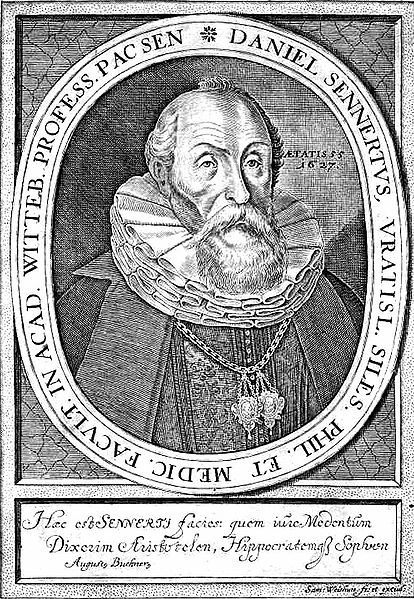
The first one was Daniel Sennert (1572-1637) who            The second one was Adriaan van den 
received his MD in 1599 from Leucorea University               Spieghel (1578-1625) who received his MD 
in Wittenberg.                                                                       in 1603 from the University of Padua.
   File:Adriaan van den Spieghel.jpg
Adriaan van den Spieghel
File:Daniel-Sennert.jpg                 
Daniel Sennert
                                             
Daniel's advisor was Jan Jessenius (1566-1621) who  
received his MD in 1591 from Leucorea University in Wittenberg. 
File:Jan Jesenius.jpg
Jan Jessenius
                     
 Both Jan's and Adriaan's advisor was Girolamo (Hieronymus Fabricius) Fabrici d'Acquapendente (1537-1619) who received his MD in 1559 from the University of Padua. He is known as the Father of Embryology.
File:Girolamo Fabrizi d'Acquapendente.jpg
Hieronymus Fabricius courtesy of Wikipedia


Girolamo's advisor was Gabriele Falloppio (1523-1562) who received his MD in 1547 from the University of Padua. 
File:Gabriele Falloppio.jpg
Gabriele Falloppio
 
Gabriele's advisor was Antonio Musa Brasavola (1500-1555) who received his MD in 1520 from the University of Ferrara.
File:Antonio Musa Brasavola.jpg
Antonio Musa Brasavola
Antonio's advisor was Niccolo (Leoniceno) da Lonigo (1428-1524) who received his MD in 1453 from the University of Padua. 
Niccolo (Leoniceno) da Lonigo

 
 Niccolo's advisor was Pietro Roccabonella Veneziano (1427-1491) who received his MD in 1455 from the University of Padua.


 Pietro had two advisors. One was Gaetano da Thiene      The second was Sigismondo Polcastro.
(1387-1465) Gaetano received his his degree from the          (1397-1473) who recieved his degree from the
University of  Padua.                                                            University of Padua. His advisor is unknown.
                                                              
Gaetano's advisor was Paulus (Paul of Venice) Venetus (1368-1428) who received his degree from the University of Padua, although he likely studied with Pierre d'Ailly at the University of Paris.
Paulus' advisor was Pierre d'Ailly (1351-1420) who received his doctorate in theology in 1381 from the University of Paris.
File:Pierre d'Ailly.jpg
Pierre d"Ailly


Although the Academictree.org website says that the lineage goes on I believe it is tenuous from this point forward. And even further beyond those things get really iffy. Although if you keep following this line, eventually you get to Jesus.


---------------------------------------------------------------------------------

Footnotes
I was stuck on Clarence Hall for a while and even got a copy of his dissertation to find out his advisor who nobody really seemed sure of. Even the dissertation did not specifically call it out. But upon finding out he was still alive, I just emailed him and my suspicions were immediately proved correct (very fast email response) that it was Si who was his advisor. Further work was easy on the internet, since there are a couple of biographies online that spell out everything I needed to keep going back until I get to Adolf von Koenen. He was a little more of an enigma to crack until I got his dissertation and was able to search for his name along with those mentioned in it (even though it was in Latin). I found a connection with one of the prominent names mentioned in his Vita at the end and found him to be mentioned as a student of Beyrich's. 

Although Beyrich's dissertation is readily available online (in Latin) it is difficult to make out who his advisor was. He studied under both Weiss (a mineralogist) and Goldfuss (a paleontologist and a zoologist). I would assume it was Goldfuss since he is noted as turning Beyrich onto Paleontology but Beyrich received his degree at Berlin where Weiss taught while Goldfuss taught at Bonn. This is why I put them both down. 

This is where I hit the goldmine. While searching for Christian Samuel Weiss I stumbled upon the Mathematics Genealogy Project and the  Academictree.org which allowed me to follow my family tree back to the 1400's. I used both of these sources and when they agreed I followed that line further back.

Once you hit a certain point back it appeared that several people along my lineage received MD's as if they were PhD's with advisors. This is contrary to today where the MD is quite distinct from a PhD. And even further back from that most scholars were theologians and philosophers so it is no wonder that my lineage could be traced back to Jesus, even if I do find that a bit tenuous.