Showing posts with label Dinosaurs. Show all posts

Saturday, November 13, 2021

Dinos in Pop Culture - LEGO Dinosaurs

 When LEGO decided to release the Dinosaur Fossils set it became a "must have" for me. These are far from the only dinosaurs LEGO has ever produced as well but besides being specifically the skeletons of the dinosaurs (and Pteranodon, which is not a dinosaur) they are set up as if they were museum displays. This makes the paleontologist heart in me happy. 


The line of LEGOs comes from their LEGO Ideas sets, which are LEGO sets that had been submitted by  users as potential builds. These ideas/suggestions are then reworked by LEGO professional builders to make them work in a mass market possibilities. This set was originally designed by Jonathan Brunn, who is a French graphic designer and reworked by the LEGO Designer Niels Milan Pedersen. 


The set itself comes with the three main fossil skeletons, Tyrannosaurus rex, Triceratops horridus, and Pteranodon longiceps. On top of that it comes with a little paleontologist, box of paleontological tools and books, as well as a "LEGO sapiens" model (i.e. the bones of a LEGO figure).  

The models are set up as skeletons in a 1:32 scale with the skeletons on a display pad complete with identification plaque. Most of each figure is adjustable as well, so that you can get the models in the pose that you really want. 

Even though they are obviously LEGO figures, the models themselves are actually quite awesome. They are not a 1-to-1 recreation of a real life skeleton, but they are as close to what would happen if a real life skeleton got put through a LEGOification machine. 

And I love the variety that you get. You have the two stalwarts of dinosaur popularity representing the carnivores (T. rex) and herbivores (Triceratops), and you also have the non-dinosaurian flying Pteranodon complete with a stand so you can place it in "flying mode". 

Your crate of goodies also comes with some bones, a magnifying glass, an egg, a cup, a rock hammer, a book about fossils, and some unidentifiable tools.  

Overall, this set earns an A+ from me.

Wednesday, March 10, 2021

Elementary Paleontology Education - Did Dinos Drag Their Tails

Coming home from school a couple of years ago (3rd grade), my daughter had some work to do in her Reading textbook. Looking over the questions, I was rather appalled by the implication that they had in this book that still persist to this day.


The question in question is number 15: "Write the letter of the part that shows the mark left by the animal's tail."

Analyzing the traces in the image above, the footprints indicate that we are likely dealing with a large theropod dinosaur, based on the shape of the foot. These three-toed impressions looks similar to a Tyrannosaurus rex or a Dilophosaurus footprint. Within the image above we can not entirely differentiate between the two because we don't have a scale to identify the size of the footprints. There are also other dinosaurs that make three-toed footprints. These include the ornithopods (like Parasaurolophus and Hadrosaurus), however their footprints are generally more rounded in nature, with less toe definition. 

Since these are likely theropod footprints, lets look at the anatomy of a theropod dinosaur. Science has basically determined that these large theropod dinosaurs walked as sort of a lever, with the hip joint working as a fulcrum. You have the front half of the dinosaur, with the head and arms on one side of the hips, laid out perpendicular to the legs, and the tail sticking straight out behind the dinosaur, also perpendicular to the legs. And if you look at the illustration given in the reading textbook, this is actually almost what is shown.


Although this is a more upright version of what this type of dinosaur looked like, it was likely closer to reality than what they were implying with the tail drag question. And even looking at the dinosaur pictured, there is no way that that dinosaur is even dragging its tail. There is a complete disconnect between the pictured animal and what the traces that it left behind indicate. Based on the size, shape, and number of fingers of the animal pictured, this is likely a Tyrannosaurus rex. And we can look at historical and modern interpretations of what the animal may have looked like.

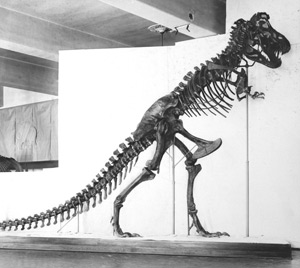
Original mount for the Tyrannosaurus rex by Barnum Brown at the American Museum of Natural History. Image courtesy of Benjamin Burger

Looking at the original mount for the T. rex above, we can clearly see that this animal looked like it dragged its tail. However, for Barnum Brown to even get the skeleton to bend like this he had to break some of the vertebrate. Which, any modern day scientist will tell you, if you need to break the skeleton to do what you want it to do, you are doing something wrong.

As mentioned above, the modern day interpretation of the T. rex stance is much more of a lever and fulcrum situation as can be seen on SUE below from the Chicago Field Museum.

SUE the T. rex from the Chicago Field Museum.

The modern interpretation of the T. rex stance clearly did not drag its tail. I can't even imagine how this animal would have gotten its tail on the ground.

Other potential tail dragging dinosaurs?

The question then comes that if theropod dinosaurs didn't drag their tails, did any dinosaurs? And the answer to that is a "not usually, but maybe at times?" There have been some indications of tail dragging by dinosaurs in the fossil record, however these are by non-theropod dinosaurs, with the most obvious one being tied to a sauropod (Foster et al., 2000). Foster et al. describe a sauropod trackway that shows evidence of a midline tail drag mark from Twentymile Wash within the Grand Staircase-Escalante National Monument, preserved within the Middle Jurassic aged Entrada Sandstone. 

However, besides this one instance, there are numerous dinosaur trackways preserved around the world with the number of tail drag traces almost nonexistent. There has been a few others tail drag traces mentioned in the literature, which have been attributed to sauropods and ornithopods, however the identification of tail drag in some of these cases were ambiguous and uncertain. So, although it is possible that some dinosaurs may have been dragging their tails, it is far from common place, and more of an abnormality than anything consistent.

What if this trace was real?

But thinking like a scientist, and knowing what we know about modern T. rex anatomy, if we did come across the trace fossils as seen above (the footprints and tail drag), how would it be classified. We can narrow this down to several possibilities:
  1. This is a true tail dragging theropod. 
    • If this were the case, it would likely be due to an injury that the animal sustained, causing it to drag its tail. An anomaly that we haven't currently found in the fossil record, but one that cannot be ruled out.
  2.  The animal itself was carrying something that was dragging along the ground.
    • This is the theory that I like to think makes the most sense. Suppose the animal had its dinner and was carry part of it back to its home or somewhere else. With little use of its arms, its mouth and legs would provide most of the functions that it would need to carry and tear apart any meat. Therefore, it is possible that a large enough body of meat would drag along the ground while being carried by the theropod.
  3. Something else made the drag mark.
    • There are numerous animals that do drag their tails, specifically reptiles, lizards, and other small animals. Although it is a possibility that a theropod came along and walked along the other animals footprints, essentially erasing them, while preserving the tail drag, this is an extremely unlikely scenario. It is also possible that is was a natural drag mark, perhaps a stick being floated down a river that drags along the riverbed. However, again it is unlikely that any animal would walk with this drag mark perfectly aligned between the footprints. 
So with the evidence displayed above, which is a set of theropod footprints and a groove aligned medially between them, I think the most likely scenario to produce such a trace would be the dragging of something, likely food, by the large theropod dinosaur. That would make this most likely a drag trace and not a tail drag trace.

Monday, November 23, 2020

Dinos of Disney - Primeval World on the Disneyland Railroad

And for my last Dinos of Disney post for Disneyland (for now at least), I am looking at something that I had heard about but for some reason never experienced except for this last trip to Disneyland.

The Dinos of the Disneyland Railroad

(AKA Primeval World)

Normally, when we rode on the railroad, we would take the Main Street, U.S.A. Station around to the various parts of the park we wanted to visit. The last stop we would get off would be at the Tomorrowland Station, because afterwards it just circles back to the beginning. So, we never felt the urge to ride from Tomorrowland to the Main Street, U.S.A. Station, however, this is where the dinosaur fun begins.   


Before even hopping on the train, they have these rotating billboards that have "advertisements" for each part of the park that the train stops at. They even have one for the dinosaur exhibit stating "Primeval World. Enter the World of the Dinosaur. Temporal Zone 200,000,000 BC".

The ride to the Primeval World begins with a trip along the Grand Canyon, specifically this Grand Canyon Diorama that was added to the railroad in 1958. The diorama is 306 feet in length and provides an exquisite view of the south rim of the Grand Canyon, which also includes some animals and trees along the way. After this you are then transported back into the Primeval World. 
"That was the Grand Canyon as we know it today, but it wasn't always that way. Quiet now, as we travel back in time, back to the fantastic Primeval World, land of the dinosaurs!"
The Primeval World was a series of Audio-Animatronics dinosaurs originally created for the Ford Magic Skyway at the 1964 New York World's Fair. The original ride was created as a time travel experience where people sat in Ford cars during the ride with the scenes narrated by Walt Disney himself. The scenes from the ride were taken from the Rite of Spring segment of 1940's Fantasia, which in and of itself had some paleontologically problematic scenes, as we will see below. Not all of that Magic Skyway experience had been transferred here, just the dinosaurs. 


The first animal we encounter is an Edaphosaurus, which unfortunately I did not get a good picture of. Edaphosaurus is a relative of the more common Dimetrodon, a synapsid from the Late Carboniferous and Early Permian time periods. Generally, this means that Edaphosaurus was not a dinosaur but closer related to mammals, and actually was completely extinct by the time any of the dinosaurs started to appear. 


The next series of animals we encounter is the group of Brontosaurus seen above. The posture of the body in these animatronics gives a sort of "loch ness" vibe to them with the curve of the neck, whereas in the real would stick out more and the tail would also be raised above the ground. The comment that their postures are incorrect is actually a general comment for all of the animals in this exhibit, as that it has been scientifically determined since these animals were created that they were able to keep their tails elevated off of the ground with their spines more or less straight. Side note: the three baby Brontosaurus were called Huey, Dewey, and Louie by Walt

The next animals on our prehistoric journey is the Pteranodon, pictured here with a group towards the back. Generally, it has been noted that their posture is not the best, especially if they are resting or walking. It has been shown that they do use all four limbs when walking, causing their wings to fold back behind them, instead of open like this. 

A up-close view of one of the Pteranodons, unfortunately the window lines tended to get in the middle of my pictures. 

The next up is a family of Triceratops watching their babies hatch. From what I can tell, scientifically, these are pretty good and the detail on them is quite amazing given when they were created. 

The next scene is a group of Struthiomimuses. The only dated aspect of these is that they likely had feathers. There are also several skeletons lying around on the ground. These skeletons are a bit difficult to view here but they include a Megalosaurus (seen here on the left) and a Plateosaurus, which is directly behind the Megalosaurus up on the hill a little bit. 

And we make it to the final shot of the train ride, which is also one of the climax shots of the Right of Spring. The most obvious complaint that we have here is that Stegosaurus and Tyrannosaurus rex lived in completely different time periods, so the possibility of this battle ever happening outside of a Jurassic Park cloning experiment is absurd. Stegosaurus lived during the Jurassic period (~150 million years ago), while the Tyrannosaurus live during the Late Cretaceous (~70 million years ago). That is more of a time difference than is between the T. rex and us now. 

Looking at the reconstructions of the dinosaurs, the T. rex could be considered to the the typical 1940's(ish) T. rex, complete with upright stance and a rather small head for the rest of its body. The shape of the skull is also completely off. They did fix the skull shape somewhat for the other T. rex in Disneyland on Big Thunder Mountain, although that one isn't perfect either. It also have 3 fingers, which most grade school kids would be able to tell you that the T. rex only has 2 fingers, while other large predators like Allosaurus typically have 3. The end of the Stegosaurus tail is also colored as if it is a spike as well, instead of just the end of its tail. This seems to indicate the creators of it gave it 5 spikes instead of the actual 4 it should have. 

Monday, October 26, 2020

Dinos in Pop Culture - Playgrounds Featuring the Dino Death Pose

 While playing with my daughter at a local park, I came across this hidden dinosaur, that brought up a couple of questions in mind. First off, what was this model based on? And why was the dinosaur positioned the way it was? I had my thoughts based on previous research I had done but I figured I would delve into it deeper. 


The dinosaur in question could be found on the back side of this rock climbing wall. 


To answer the first question, the mold appears to be modeled on the Gorgosaurus specimen at the Royal Tyrell Museum in Alberta, Canada. Gorgosaurus is a tyrannosaurid that is most closely related to Albertosaurus (hence the original identification of the below fossil as an Albertosaurus). It lived during the Late Cretaceous time period between 76.6 and 75.1 million years ago in Alberta, Canada and potentially Montana, USA. 

Gorgosaurus from the Royal Tyrell Museum in Alberta. Image courtesy of the Royal Tyrell Museum.

The first thing that is noticeable about the playground mold is that it is not an exact match for the museum specimen though. The mold skull is far smaller, the neck has many fewer vertebrae, and the curve of the neck isn't as pronounced, among a host of other issues. But the general feel of the playground dino is the same as the actual fossil. The location of the limb bones is near exact as well as the general posture of the dinosaur. It's as if someone tried to create a simplified image of the real dinosaur to the point of being wrong but "close enough".

Death Pose

Another noticeable thing about the dinosaur (in both cases), is the position of the body. This position is frequently referred to as the "death pose" (technically called the "opisthotonic posture"), and this is far from the only fossil to be found in a similar situation. Typically, what you see with this posture is that the head is curled backwards towards the tail and the tail is curled forward (as much as possible) towards the head. But why are so many fossils found this way? 

Upon initial discovery, it was thought that the animals lived like this while they were alive. However, that has proven to be false, so something must of happened to their bodies between the time that they were healthy and alive to the time that they were locked in stone (i.e. fossilized) forever. There are a couple of theories on what can cause this body position, but they can be boiled down to two: 
  1.     Things that happened to the animal while it was alive.
  2.     Things that happened to the animal after it died.
Scientists have been debating this for decades but it likely comes down to both sides are potentially correct. There are things that can cause the animal to be posed like this during life and after death. 

In life, this posture is possible by severe neurological (brain) damage, which would result in a curved spine while pulling the head and heels backwards. This situation can be produced by multiple causes including meningitis, tetanus, poisoning, asphyxiation, as well as a host of other diseases. While these causes have most notably been recorded in humans, animals are not immune from them either, specifically brain damage from drowning or asphyxiation and/or poisoning. These are instances where the "death throes" that produce this posture could be created in life, or more accurately called "perimortem", or near death.

There is also research that shows this posture can be created after death (postmortem). The bend of the spine is most naturally backwards. In most animals bending the neck downwards takes a lot of force, while upwards is quite natural.  But after death, although the muscles initially relax, ligaments and tendons start to contract, forcing the spine around as they shrink. Desiccation of the corpse has also been attributed as a cause of post-mortem spinal curve.  

As a side note: The tail on a dinosaur does not typically curl backwards as it does in mammals. You can actually see this in the Gorgosaurus fossil above, where the tail, even though it is bent upwards, does not actually curve towards the end. Dinosaurs have vertically stiff tails that stick out to counterbalance their heads. This stiff tail is not capable of bending up or down, but can sway side to side. This stiffness is preserved in death.


Tuesday, October 06, 2020

Paleo Bucket List - SUE the T. rex

I don't know if all paleontologists have this, but I know I certainly do: a Paleo Bucket List. A list of fossils, localities, or rock units that are so famous and revolutionary to the field of paleontology, geology, and/or biology that one must gaze upon them just once to full appreciate them. I was finally able to hit up one of my bucket list items when I was in Chicago in 2016, and then again to see the updated mount in 2019: 

Paleo Bucket List

SUE, the Tyrannosaurus rex

SUE (AKA FMNH PR 2081) is a difficult fossil to sum up quickly because so much has happened to her since she was discovered. And that's one of the reasons she has become a bucket list item, for her storied history.

SUE the T. rex in the field as discovered by Sue Hendrickson. Image was taken at the Field Museum.

SUE the T. rex was initially discovered by Sue Henderson, and named after her. After excavation, the fossil was determined to be 90% complete, far more complete than any other T. rex at the time and is still one of the most complete fossil T. rexes ever discovered. SUE was contentious because of where she was discovered and who owned the land that she was discovered on. In short, the Black Hills Institute (BHI) in South Dakota, of which Sue Hendrickson was a part of, discovered the T. rex on a ranch on the Cheyenne River Sioux reservation. A dispute erupted over the ownership of the fossil between the BHI, the rancher Maurice Williams, and the Cheyenne River Sioux tribe.

This prompted the federal government to step in and claimed the fossil. Eventually, it was determined that the land under which the fossil was found on was tribal land, held in trust by the US Government. So the land owner, Maurice Williams, ended up with the fossil, under trust from the US Government. Williams was then granted leave by the US Government to sell the fossil through auction. The fossil was shipped to Sotheby's in NY and sold in 1997 for $8.36 million. The purchasing winner was the Chicago Field Museum with significant funding from the Walt Disney Company and McDonalds. SUE remains the most expensive fossil ever sold to this day. There have been several books, journal articles, and documentaries about the controversy surrounding SUE. Dinosaur 13 was one of the more popular recent documentaries from 2014, although after watching it, I had a sour taste in my mouth from the blatant bias against the US government. 

So, coming back to SUE. Back in August of 2016 when I visited the Field Museum, she was housed in the main Stanley Field Hall of the Field Museum. In this shot below you can see the reconstruction painting of SUE in the background up on the balcony. SUE's original skull was originally housed just below the painting. 

Mount of SUE the T. rex in August of 2016

Mount of SUE the T. rex in August of 2016

Mount of SUE the T. rex in August of 2016 from up above.

Then in 2018, SUE got a new home within the museum. She now has her own special exhibit. I was able to visit the new home in April of 2019.

Directions to SUE's new home within the Field Museum

SUE in her new home with lights capable of highlighting various portions of the skeleton during the automatic presentation that runs every few minutes.

SUE in her new home from the front. This space is a lot smaller, really emphasizing SUE's enormous size. 

Look how happy she is in her new home

SUE was discovered within the Hell Creek Formation and has been dated to being about 67 million years old. This makes her one of the last dinosaurs of the Mesozoic. She is 40.5 feet and 13 feet tall, has been determined to be ~28 years old when she died, and is estimated to have weighed around 9 tons. Besides being nearly complete, one of the really cool things about SUE is the entire reconstruction of the skull. When discovered and pieced back together, the skull of SUE was essentially squished (all of which happened after death and burial). The skull itself also weighs over 600 pounds, so a reconstruction was needed in order to just display the skull. Luckily the original skull is also displayed nearby in the current exhibit as well.

Forward view of the actual skull of SUE

A little more head-on view of the actual SUE skull

View of the left side of the actual SUE skull.

View of the remodeled SUE skull on the left side for comparison. 

There is also, to my immense delight, a SUE store!

 
Sign for the SUE Store

In exchange for putting up the cash to buy SUE, McDonalds and the Walt Disney Corporation both received models of SUE. You can see Disney's SUE model, down in Animal Kingdom at Walt Disney World. 

SUE at Walt Disney World. Sorry for the darkness, I was only able to see her at night.

Another view of SUE in Walt Disney World

SUE's plaque at Walt Disney World.


References

Sunday, October 04, 2020

Dinos in Pop Culture - Brachiosauruses Everywhere in Chicago

Here is another Chicago geology post, this time focusing on some Field Museum dinosaurs. When visiting Chicago in 2016, one of my goals was to hit up the Field Museum, which happens to be one of the most famous paleontology museums in the world. While I was there I noticed the skeletal mount of a Brachiosaurus outside the main building. 

Brachiosaurus mount outside the Chicago Field Museum

It's hard to not notice a 40 foot high, 75 foot long Brachiosaurus standing guard of the museum. Besides being an outside stalwart of the museum, it is actually pretty famous for other reasons. They dress up the mount for various Chicago sports teams with a XXXXXL jersey during the different sports seasons (I don't know the actual size but apparently it's big). 

2018 photo of the Brachiosaurus donning a Cubs Jersey. Image courtesy of CBS Chicago

However, while I was leaving Chicago, I traveled United Airlines through O'Hare airport and I noticed another Brachiosaurus mount within the airport.

Brachiosaurus mount in O'Hare Airport

Brachiosaurus mount in O'Hare Airport

And it wasn't until looking at the photos for this post that I realized that the mounts were practically identical. Turns out, they are the same mount. 

The original Brachiosaurus specimen was discovered in 1900 by the Field Museum's first paleontologist, Elmer Riggs. The original skeleton was discovered in the Late Jurassic (~150 million years ago) Morrison Formation from western Colorado near Grand Junction. In total, the skeleton was discovered to have been 20% complete. Eventually, a mount of the skeleton was made using fiberglass replicas of the original Brachiosaurus altithorax holotype material, a couple of other Brachiosaurus specimens found later, and Giraffatitan brancai material (a closely related specimen from Tanzania). 

In 1993, the mount was set up within the Stanley Field Hall at the museum, but then was moved out to its current location within O'Hare airport in 1997. The mount was then recreated using plastic bones and a steel frame, all-weather materials, in 1999 to be placed on the western terrace of the museum, where it can be seen today. 

Wednesday, November 13, 2019

Geology Fun Fact - Dinosaurs and Grass

Geology Fun Fact

Question: Did dinosaurs eat grass?

There has been a continuous debate over the pictures showing dinosaurs eating grass and scientists frequently stating that it didn't happen because grass didn't evolve yet, or grasses during the Mesozoic (the Age of the Dinosaurs) were primitive. However, recent research has shown that there were more advanced grasses during the Mesozoic, perhaps even as far back as 100 million years ago (Ma). Non-avian dinosaurs first appear ~230 Ma and went extinct about 65/66 Ma, so they had access to grasses for about ~20% of their existence.


Click HERE for more Geology Fun Facts!

Wednesday, November 14, 2018

Geology Fun Fact - Fossil Fuels

Geology Fun Fact

Question: Are fossil fuels actually made of dinosaurs? 

No! Despite the common misconception, most fossil fuels do not actually come from dinosaurs or fossils for that matter. Oil and natural gas formed mostly from bacteria that died and blanketed the bottom of the sea before being buried and “cooked” into the fossil fuels we all know and love. Coal on the other hand, does sort of come from fossils. Coal was formed in prehistoric swamps from plant matter that never biodegraded due to low oxygen content of swamps and preserved the organic matter to be “cooked” into coal.


Friday, November 02, 2018

Geology Fun Fact - Dinosaurs to Birds

Geology Fun Fact

Myth: Dinosaurs are Extinct. 

While all non-avian dinosaurs are extinct, there is overwhelming evidence that birds are descendants of dinosaurs, making them dinosaurs themselves. So, the next time you eat a turkey or a chicken, you are eating a dinosaur.


Thursday, October 25, 2018

Geology Fun Fact - Old Diamonds

Geology Fun Fact

Theory: Diamonds are older than the dinosaurs

Actuality: The youngest naturally occurring diamond is over 900 million years old, while the earliest dinosaur is estimated to be less than 250 million years old. 


Monday, April 04, 2011

Dinosaur Scares the Bejesus Out of Some Kids

I was made aware of this by my sister-in-law where they were promoting the Walking With Dinosaurs show in Sydney. I really wanted to see the show when it came through Salt Lake City but it was waaaay to expensive, so we had to pass.

Pretty cool to watch the kids freak out, although I didn't know that it was a guy in the suit until this video. I used to think they were all animatronic dinosaurs. That took away from it a little because you could easily see the guy's legs since the dino's legs weren't attached. Cool none-the-less though. Hopefully it will promote some future scientists.

Thursday, January 20, 2011

Finally the TRUTH about Dinosaurs comes to light

Well now we finally have it. The truth about dinosaurs. I was recently sent this article and as it starts out it isn't so bad. It actually makes sense and is correct:

Technically speaking, the term “dinosaur” should be used only to describe a particular group of reptiles that lived on land. In some books, however, you may find an author describing some creatures that flew in the air as “flying dinosaurs.” In other books you may find the author calling certain animals that lived in the water “aquatic dinosaurs.”

We could call these creatures that flew in the sky and swam in the oceans “dinosaur-like” animals, but it would be incorrect to say that they are dinosaurs.
Not bad. But then we get into the meat of the story:

Whatever their differences, however, there is one thing true dinosaurs do have in common with dinosaur-like animals — we can know for certain they all were created by God!
Oh no. I have a feeling this isn't going to end well. Here are some other clips from the article.
Inostrancevia was not a true dinosaur, but one of the extinct reptiles of the order Therapsid, falsely imagined by evolutionists to be the ancestors of mammals.
Yup. Thats what I thought.
[Owen] realized that dinosaur fossils were the remains of creatures buried long ago, most likely in the global flood of Noah’s time.
Well I can't imagine what else would have covered them. Not river flooding or anything. People along the Mississippi river or Brazil wish to comment on that?

This is the best part. How a fossil is made:
1. The Great Flood suddenly buried a dinosaur under tons of water and mud. Escape was impossible.
2. The dinosaur’s body was trapped by layers of sediment laid down by the Flood’s waters. Soft body parts decayed, but the bones remained.
3. God caused high mountains to rise up and deep valleys to sink down so that the Flood waters “fled” and “hastened away” into new, enlarged ocean basins (Psalm 104:5–9). The earth began to dry out, and minerals in the mud, sand, and water replaced the bones — and they became like rock.
So, what happened to plate tectonics? You know that force that moves the continents and pushes up mountains? I'm pretty sure we can actually measure the movements of the plates. How does that come into this.

Well I just felt like I should pass on the pearl of wisdom that was bestowed upon me. Thanks (?) Brendan H. for the article.

Friday, September 25, 2009

How to Build a Dinosaur

So I ran across this article (Canadian scientist aims to turn chickens into dinosaurs) describing how one scientist wants to build a dinosaur from a chicken embryo. Although I am fully in support of this (I think it is really cool) he makes a comment:

 "If I can demonstrate clearly that the potential for dinosaur anatomical development exists in birds, then it again proves that birds are direct descendants of dinosaurs."

Now typically, most (and by most I mean at least 95%) of scientists do not debate this. It is a pretty well established fact (fact meaning that it is still a theory but a pretty damn well good one, like gravity) that birds came from dinosaurs. So who is he trying to prove this to? Anyone who does not believe in evolution won't believe the study anyway? I don't know, just my 2 cents.