Showing posts with label Trace Fossil. Show all posts

Wednesday, March 24, 2021

Neoichnology - Beetle Traces in the Sand

Ichnology is the scientific study of traces and traces of animals, specifically these tracks and traces are typically preserved in the geological rock record. I go into depth on what exactly is a Trace Fossil in a previous post. 

Neoichnology is the scientific study of tracks and traces in modern sediments, made by currently extant (living) organisms. Scientists, specifically ichnologists, biologists, geologists, and paleontologists, will look at modern traces in order to better understand fossil traces. 

As someone who is an ichnologist by training, I am fascinated by the traces left behind by both modern and ancient organisms and I will frequently find myself taking pictures of tracks and traces left behind in various substrates. While on vacation in central Utah, at Yuba State Park, I came across one such series of interesting traces within the sand dunes of the park.


Trace fossils, like regular fossils, are also named based on their morphology. That means different traces will get an ichnospecies and an ichnogenus (just like an animal is identified by its genus and species). Modern day traces, although not technically trace fossils, can often be tied back to traces in the rock record. So, for these tracks we can identify an ichnogenus and an ichnospecies for them just as if they were trace fossils. For the trace above it would most likely be identified as Lithographus (as the ichnogenus). [Thanks to Simon Braddy and Patrick R Getty on the Ichnology Facebook group for help with the diagnosis.] Taxonomic classification of trace fossils (inchnotaxonomy) has a defined set of characteristics known as a diagnosis for each particular ichnogenus and ichnospecies. The classification diagnosis for the ichnogenus Lithographus is as such (according to the emended diagnosis of Minter and Braddy, 2009) :
Trackways consisting of staggered to alternating series of up to three tracks, at least one of which is linear to curvilinear, whilst they may also be ovoid or crook shaped. The tracks in a series have different orientations. The longest track is parallel to slightly oblique to the mid-line of the trackway and is either the middle or the inner track. The shortest track is orientated antero-laterally, or parallel, to the mid-line and is either the inner or the middle track. The middle-sized track is generally orientated perpendicularly to the mid-line but can also be orientated postero-laterally or antero-laterally. Straight or sinusoidal single or paired medial impressions may also be present.


Trace fossils in the rock record are also nearly impossible to definitively attribute to a specific animal, unless that animal was physically located in connection to the trace. Often times the maker of a trace fossil can be fairly accurately assumed based on the morphology of the trace and the morphology of animals living at the time and in the same region as the trace fossil. Dinosaur footprints often fall into this category, where specific footprint morphologies can often be tied back to a potential maker. Other times it is completely unknown who made a trace fossil. In modern day traces, it is often much easier to accurately identify the trace maker, since we can often find them making the trace, or at least nearby. As in this case, upon closer inspection, we can actually see the trace maker making the traces. It turns out that these traces were left behind by the beetle seen in the photo, the Ten-lined June Beetle (Polyphylla decemlineata). 

The Ten-lined June Beetle (Polyphylla decemlineata). Image courtesy of Bug Guide.

The Ten-lined June Beetle is a fairly common beetle found across western North America with verified occurrences from Nebraska west to the Pacific Ocean, and California north into Canada.

Verified Ten-lined June Beetle occurrences according to Bug Guide.

And of course, as any good scientist would do, I wouldn't want a picture of a trace without a scale bar. And since I didn't have a scale bar with me at the time, my flipflop stood in for reference.


References
https://bugguide.net/node/view/23563/data

Wednesday, March 10, 2021

Elementary Paleontology Education - Did Dinos Drag Their Tails

Coming home from school a couple of years ago (3rd grade), my daughter had some work to do in her Reading textbook. Looking over the questions, I was rather appalled by the implication that they had in this book that still persist to this day.


The question in question is number 15: "Write the letter of the part that shows the mark left by the animal's tail."

Analyzing the traces in the image above, the footprints indicate that we are likely dealing with a large theropod dinosaur, based on the shape of the foot. These three-toed impressions looks similar to a Tyrannosaurus rex or a Dilophosaurus footprint. Within the image above we can not entirely differentiate between the two because we don't have a scale to identify the size of the footprints. There are also other dinosaurs that make three-toed footprints. These include the ornithopods (like Parasaurolophus and Hadrosaurus), however their footprints are generally more rounded in nature, with less toe definition. 

Since these are likely theropod footprints, lets look at the anatomy of a theropod dinosaur. Science has basically determined that these large theropod dinosaurs walked as sort of a lever, with the hip joint working as a fulcrum. You have the front half of the dinosaur, with the head and arms on one side of the hips, laid out perpendicular to the legs, and the tail sticking straight out behind the dinosaur, also perpendicular to the legs. And if you look at the illustration given in the reading textbook, this is actually almost what is shown.


Although this is a more upright version of what this type of dinosaur looked like, it was likely closer to reality than what they were implying with the tail drag question. And even looking at the dinosaur pictured, there is no way that that dinosaur is even dragging its tail. There is a complete disconnect between the pictured animal and what the traces that it left behind indicate. Based on the size, shape, and number of fingers of the animal pictured, this is likely a Tyrannosaurus rex. And we can look at historical and modern interpretations of what the animal may have looked like.

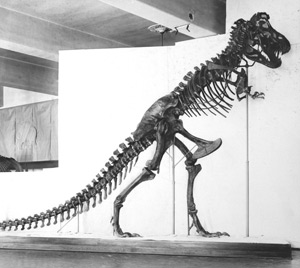
Original mount for the Tyrannosaurus rex by Barnum Brown at the American Museum of Natural History. Image courtesy of Benjamin Burger

Looking at the original mount for the T. rex above, we can clearly see that this animal looked like it dragged its tail. However, for Barnum Brown to even get the skeleton to bend like this he had to break some of the vertebrate. Which, any modern day scientist will tell you, if you need to break the skeleton to do what you want it to do, you are doing something wrong.

As mentioned above, the modern day interpretation of the T. rex stance is much more of a lever and fulcrum situation as can be seen on SUE below from the Chicago Field Museum.

SUE the T. rex from the Chicago Field Museum.

The modern interpretation of the T. rex stance clearly did not drag its tail. I can't even imagine how this animal would have gotten its tail on the ground.

Other potential tail dragging dinosaurs?

The question then comes that if theropod dinosaurs didn't drag their tails, did any dinosaurs? And the answer to that is a "not usually, but maybe at times?" There have been some indications of tail dragging by dinosaurs in the fossil record, however these are by non-theropod dinosaurs, with the most obvious one being tied to a sauropod (Foster et al., 2000). Foster et al. describe a sauropod trackway that shows evidence of a midline tail drag mark from Twentymile Wash within the Grand Staircase-Escalante National Monument, preserved within the Middle Jurassic aged Entrada Sandstone. 

However, besides this one instance, there are numerous dinosaur trackways preserved around the world with the number of tail drag traces almost nonexistent. There has been a few others tail drag traces mentioned in the literature, which have been attributed to sauropods and ornithopods, however the identification of tail drag in some of these cases were ambiguous and uncertain. So, although it is possible that some dinosaurs may have been dragging their tails, it is far from common place, and more of an abnormality than anything consistent.

What if this trace was real?

But thinking like a scientist, and knowing what we know about modern T. rex anatomy, if we did come across the trace fossils as seen above (the footprints and tail drag), how would it be classified. We can narrow this down to several possibilities:
  1. This is a true tail dragging theropod. 
    • If this were the case, it would likely be due to an injury that the animal sustained, causing it to drag its tail. An anomaly that we haven't currently found in the fossil record, but one that cannot be ruled out.
  2.  The animal itself was carrying something that was dragging along the ground.
    • This is the theory that I like to think makes the most sense. Suppose the animal had its dinner and was carry part of it back to its home or somewhere else. With little use of its arms, its mouth and legs would provide most of the functions that it would need to carry and tear apart any meat. Therefore, it is possible that a large enough body of meat would drag along the ground while being carried by the theropod.
  3. Something else made the drag mark.
    • There are numerous animals that do drag their tails, specifically reptiles, lizards, and other small animals. Although it is a possibility that a theropod came along and walked along the other animals footprints, essentially erasing them, while preserving the tail drag, this is an extremely unlikely scenario. It is also possible that is was a natural drag mark, perhaps a stick being floated down a river that drags along the riverbed. However, again it is unlikely that any animal would walk with this drag mark perfectly aligned between the footprints. 
So with the evidence displayed above, which is a set of theropod footprints and a groove aligned medially between them, I think the most likely scenario to produce such a trace would be the dragging of something, likely food, by the large theropod dinosaur. That would make this most likely a drag trace and not a tail drag trace.

Wednesday, January 18, 2017

Random Dino Pic - Bird Footprints

Another random pic I had come across. Some modern dinosaur (bird) prints along Jones Beach on Long Island. These are likely seagull prints if I recall correctly. 


Monday, December 17, 2012

Geology on the Road - St George, UT

Here are some pictures from the St George Dinosaur Discovery Site at Johnson Farm in southern Utah from a tour i was given after the SVP annual meeting last tear. Very nice trackways. I need to go back and get better pictures sometime.


Monday, August 13, 2012

Geological Quote of the Week

Posts have been slow going but I have finally finished my redesign of Dinojim.com. Go and check it out. My posts should start to pick up from here.

This next quote discusses trace fossils, in particular dinosaur footprints. I was reminded of this by a conversation between Tony Ekdale and Tony Martin (of Life Trace of the Georgia Coast blog). The paper describes dinosaur footprints that were found in the ceiling of coal mines.

"Dinosaur footprint casts which extend down from the roof several inches are a nuisance where the coal seam is thin, causing the roof to be low; mine workers continually bump their heads on them. More serious problems have existed with them since mining began in the area in the early part of the century, because they fall and kill or seriously injure mine workers.... We are unaware of other lethal trace fossils, nor do we know of other circumstances where dinosaur activity has contributed to the possible death of human beings."
You can check out the other quotes at my site by clicking HERE.


Parker, L.R., & Rowley, R.L.J., 1989, Dinosaur Footprints from a coal mine in East-Central Utah, in Gillette, D.D., and Lockley, M.G., Eds., Dinosaur Tracks and Traces: New York, Cambrdge University Press, p. 361-366.

Wednesday, February 01, 2012

What are ... Trace Fossils?

I have been meaning to start a new series where I describe certain attributes in geology, and what I am working on in particular, in a new series called What are Wednesdays. The first entry in this group is called What are ... Trace Fossils? I picked this topic because this is what I am working on and basically it is the easiest for me to write up. This won't be a weekly series but one that comes up from time to time as I find interesting things to write about. If you have anything you would like me to write about please feel free to email me or place it in the comments.

So on to the topic, What are Trace Fossils? Trace fossils are not like your typical fossil. They are basically what an animal creates as it does stuff. Stuff can include walking, burrowing, sitting, eating, living, etc. Whenever an animal interacts with the world around it, it leaves evidence, a trace if you will. These traces are what I study. They are not the actual animal but sometimes are found in association with the animal. The easiest way to visualize this that I can think of is with footprints in the snow (as seen below). Footprints are the most basic type of trace fossil. They illustrate locomotion of an organism, whether it is a human, a rabbit, an insect, or anything in between.


But why study trace fossils? What can they tell us other than an organism was there? Well look at the footprint above. You can tell a lot by the spacing of the prints, the shape of individual prints, and even what information may be missing. The shape tells us what animal possible made it. The spacing and inclination of the prints tell us the speed that it was moving and possibly if there was something wrong, like a limp. If there is more than one set of prints you could tell if they were traveling in groups, or maybe even being hunted. There is a lot of information that can be gleamed even from a simple set of tracks.


Now just looking at the three above pictures you can tell that different organisms made them and possibly even what they were doing when they made them, looking for food, searching for shelter, migrating, snowshoeing, etc.

Now take this information and apply it to the rock record. Rocks record things similar to snow except that it has the potential to remain forever. There are many people who study dinosaur tracks just like we were looking at the tracks in the snow above. I personally study burrows on the bottom of the ocean made by some unknown invertebrate animals. Different types of tracks and trails are made in different environments and knowing what environment that is, it makes it possible to determine the environment of deposition of the rock by just knowing what a certain track looks like. It is actually a very useful tool and one that not only paleontologists use but many geologists for determining different aspects from what the ancient environment was to using them to find oil.

I will probably go into this in more detail at a later date but for some good trace fossil blog posts check out  Life Trace of the Georgia Coast by Tony Martin, an expert ichnologist from Emory University. Any questions please feel free to ask.